Recognized expert in 'Sick Building Syndrome', Mike Jawer has discovered a potential link between environmental sensitivity and psychic phenomena. ...


Skeptiko – The Interview Archive Behind Future of Inquiry
Long-form conversations on consciousness, science, spirituality, skepticism, AI, and contested evidence.




Recognized expert in 'Sick Building Syndrome', Mike Jawer has discovered a potential link between environmental sensitivity and psychic phenomena. ...

Interview with renowned psychic detective Noreen Renier. photo by Samuel Globus Join host Alex Tsakiris for an interview with Noreen Renier...

Are precognitive dreams real? Andy Paquette is a dream researcher who has compiled more than anyone in history. Dreaming of someone death is scary...

Interview with anthropologist Jack Hunter on spirit communication in other cultures and the significance it might have for parapsychology. Photo...

Interview with Loyd Auerbach on remote-viewing, Project Stargate, and the misunderstood history of psychic spying. Join Skeptiko host Alex...

Interview ith Dr. Diane Powell about research into telepathy in autistic savant children. Join Skeptiko host Alex Tsakiris for an interview with...

Interview examines the connection between ancient yoga practices and the science of extended human consciousness. Join Skeptiko host Alex Tsakiris for an interview with Dr. Dean Radin author of, A Supernormal: Science, Yoga, and the Evidence for Extraordinary Psychic Abilities. During the interview Radin explains how he science can approach such topics: Alex Tsakiris: I wonder if we’re nibbling around at the edges of something that we have to swallow whole. As you mention in your book, Supernormal, and have mentioned previously in this interview, these yogic traditions don’t point to supernormal powers. In fact they go to great lengths to say, “Hey, it’s not about these supernormal powers. Don’t worry about them. It’s about changing your connection and how you relate to—for lack of a better word—God.” If we’re not willing to tackle the Divine then we’re playing a different game but are we playing the game? Dr. Dean Radin: That’s a very good point. It’s true that the yogic path and many of these other mystical paths are basically pointing to enlightenment. Enlightenment is so far away from where science is that it’s probably too far a reach for now. And it’s also true that these traditions say you’re going to bump into these psychic things and don’t pay attention to them because they’re just yardsticks on the way to something more interesting. I would say that from the ancient traditions that advice was probably sound. Well, we’re in the modern age now and what science is able to do is study not the depths of enlightenment but we certainly can study the very place where mind and matter meet. It’s where the deep subjective and deep objective meet, and that is psychic phenomena. So the reason why the book is an entrée into that, it says you know what, science? We don’t know yet as scientists how to go all the way down to or all the way up to the enlightenment but we can begin to go much, much deeper than we have before. And in the process of studying the very area, that very boundary that the ancients would say not to pay attention to, well, we have to pay attention to that. (continued below) Dr. Radin's Webpage Click here for YouTube version Click here for forum discussion Play It Listen Now: Download MP3 (37 min.) Read It: Today we welcome Dr. Dean Radin to Skeptiko. He’s here to talk about his new book, Supernormal: Science, Yoga, and the Evidence for Extraordinary Psychic Abilities. Dr. Radin, of course, is Chief Scientist at the Institute of Noetic Sciences where he’s become one of the world’s best-known researchers on extended human consciousness. His two previous books, The Conscious Universe, and Entangled Minds, were truly ground-breaking and provide the scientific foundation for much of the current interest there is in this field. Dr. Radin, welcome to Skeptiko. Thanks so much for joining me. Dr. Dean Radin: Thanks, Alex. It’s a pleasure to be here. Alex Tsakiris: A lot of people are very excited about this new book of yours, Supernormal. Can you start just by telling us briefly what it’s about? Dr. Dean Radin: Well, one way of getting into the topic is that you may know that the Dali Lama for years now has been having dialogues with scientists on the relationship between Buddhist ideas and practice and science. Primarily physics and the neurosciences. One of the things that you see when you read the transcripts of what goes on in these meetings, and have spawned a number of popular books as well, is that the Dali Lama is very interested in science and the practice of science and what science has discovered. He has said many times that if science demonstrates that something about Buddhist practice or beliefs is incorrect that they’ll change their beliefs and practices. They’re after the truth. So that’s laudable. You would hope then that the same would be true on the scientific side, that if some scientific assumptions turn out not to be completely correct that scientists will correct them, as well. But after reading the transcripts you see that what we’re dealing with is an asymmetry. There’s a lot of interest on the part of the Buddhists on what science has to say but there’s so far very little interest on the part of science on what Buddhism has to say. You see this in stark contrast when the Dali Lama repeatedly tries to bring up issues about reincarnation and about the use of the Oracle and other things that we might consider to be psychic phenomena or related to that. The scientists present usually know nothing about these topics and they dismiss them. They dismiss them in a kind and gentle way so they don’t piss off the Dali Lama but nevertheless they say there’s no evidence so we can go on to other topics. I was just struck with this because for one thing, it really shows that the people that are talking to the Dali Lama are very straightforward, mainstream, very good at what they do, but they don’t actually know what they’re talking about when they dismiss these topics. And in almost every meeting there’s the Dali Lama or somebody else at the meeting who will try to raise well, what about telepathy? What about these issues? And it doesn’t go anywhere. So I was becoming annoyed at watching this year after year and I decided to write a book that looked in more detail at the origins of why the Dali Lama and other people say these things and what’s wrong with science.
...
Interview with author and parapsychology investigator Michael Tymn examines the work of Leonora Piper. Join Skeptiko host Alex Tsakiris for an interview with Michael Tymn author of, Resurrecting Leonora Piper: How Science Discovered the Afterlife. During the interview Tymn talks about his research: Alex Tsakiris: There are two ways we can look at this turn of the 20th century history. We can look at it in terms of forgotten history, which is the angle you take. If only we could go back. If an honest person, an open-minded person would look at this data it’s pretty hard not to be extremely aware that there is a significant amount of this history that’s been lost. But, I’ve got to wonder if there isn’t a totally different way of looking at this history. Isn’t it a textbook game plan for the kind of scientism, for the spirit of denial that we live in today? If you want to look at how to take overwhelmingly significant evidence and bury it, sweep it under the rug, and embarrass all the people who’ve touched it, here’s the way to do it. Mike Tymn: I agree. That’s one of the reasons I wrote this book and the four other books that I’ve written. It’s to try and resurrect this stuff because it’s so little-known. I’ve talked to a number of parapsychologists and they don’t know it themselves. I remember one who didn’t even know who Frederic Myers was. You talk about Leonora Piper, Sir Oliver Lodge, or Gladys Osborne Leonard, they’re all names they recognize but they don’t know any of the history. I don’t know what they teach them when they’re pursuing their degrees in parapsychology but they seem to avoid the early stuff. Michael Tymn's Website Click here for YouTube version Click here for forum discussion Play It Listen Now: Download MP3 (45 min.) Read It: Today we welcome Michael Tymn to Skeptiko. Mike is the author of several books relating to afterlife communication and mediumship including, The Articulate Dead, The Afterlife Revealed, and his latest that we’re going to talk about today, Resurrecting Leonora Piper: How Science Discovered the Afterlife. It’s a book published by White Crow Books which is a place where you’ll also find Mike’s excellent blog. Mike, welcome back to Skeptiko. It’s great to talk to you again. Mike Tymn: Thank you very much for having me on, Alex. Alex Tsakiris: So you’ve written this book about Lenora Piper, someone who many people who are interested in mediumship and history in general might know, but I think there are a lot of people who don’t know who Leonora Piper was. I guess that’s the natural place to start.
...
Interview with psychic medium researcher Dr. Julie Beischel explores the practical applications of a reading from a psychic medium. Join Skeptiko host Alex Tsakiris for an interview with Dr. Julie Beischel author of, Among Mediums: A Scientist’s Quest For Answers. During the interview Beischel talks about her research: Alex Tsakiris: We’re taking these very deep, personally meaningful topics in a very stark, scientific, clinical way, and that ok because it helps us get some distance from it. But on this issue of grief, if we look at it the way you have, it really breaks down pretty nicely as a question we can ask scientifically. There are people who report this condition. We’ll call it grief. We treat this condition. We send them to a talking psychologist or psychiatrist and that person talks—talks—talks—talks. Then we measure afterwards. Sometimes they’re better; sometimes they’re not. Or, we send them in and to get some kind of pharmacological treatment. They get these little pills and they take them, pop--pop--pop. They either get better or they don’t. We measure that. You’re suggested that there are some other people, ones that have a had a reading with a medium and they report that this has relieved them of their grief. And in the same way we’re measuring these other treatments, we can measure them. That is how it breaks down, isn’t it? Dr. Julie Beischel: Yeah. And, that’s my training -- drug trials. I used to design these kinds of experiments. There’s a protocol, and there’s a control group, and a treatment group, just like a drug trial. Instead of a drug it’s a mediumship reading. I designed this very specific protocol using a standardized grief instrument and two different funders have found it to be not what they were looking for. But it needs to get done. We’re now in the process of reaching out to the public to try and get support for that study. It really needs to be done. The same thing like when we just want to look at the validity of the mediumship information. We have to start at the beginning. Are they reporting specific and accurate information? Does it make people feel better? We did a pilot study and people reported anecdotally that it made them feel better. Dr. Julie Beischel's Website Help Support Dr. Beischel's Grief Research Click here for YouTube version Click here for forum discussion Also of Interest: Gerald Gaura, a Psychotherapist treating acute, emergent psychospiritual crises, and anomalous phenomenon. Visit his blog at Parapsychotherapy X Play It (Interview With Dr. Julie Beischel) Listen Now: Download MP3 (55 min.) Read It: Today we welcome Dr. Julie Beischel to Skeptiko. As Founder and Head of Research at the Windbridge Institute, Julie is one of the world’s leading researchers studying psychic mediums. Julie holds a Ph.D. in Pharmacology and Toxicology from the University of Arizona. She’s here to talk about her new book, Among Mediums: A Scientist’s Quest for Answers. Dr. Beischel, welcome. I guess for those of us with a long memory I should say welcome back to Skeptiko. Dr. Julie Beischel: Thank you so much for having me again.
...
Interviews from the 2012 Parapsychology Association conference with Dr. Daryl Bem, Dr. George Williams, Dr. Athena Drewes and Dr. Robert Van de Castle. Join Skeptiko host Alex Tsakiris and Dr. Richard Grego for interviews from the 2012 Parapsychology Association conference. During one of the interviews Dr. Daryl Bem reveals the secret psychologists need to know about quantum theory: Dr. Daryl Bem: Quantum theory, quantum mechanics, has never had an empirical failure. That is, to the degree you can measure, within the error of measurement, every prediction made by quantum mechanics has come true. The thing that so boggles the mind of physicists in the 20th Century was no one knows how it works. So even Richard Feynman, who won a Nobel Prize for all of this said, “Stop beating yourself up by asking ‘But how can this be?’ Nobody knows how this can be.” And psychologists and non-physicists generally don’t know that conundrum exists in physics. They say, “Well, I don’t have the mathematical knowledge to know what quantum mechanics is.” They should give themselves more credit. No one knows. No one has an understanding of the mechanics of how it works. Now some psi researchers actually think quantum mechanics does contain the seeds of an explanation. It has to do with what we call “Quantum Entanglement.” Now, there are technical arguments why that won’t work, but every week in physics there’s usually some new paper that shows entanglement at higher temperatures than we would have expected. Or, at longer distances. Or, at a more macro level. So some of psi researchers believe that’s this is going to be it. Dr. Richard Grego's Website (full audio interviews) Click here for YouTube version Click here for forum discussion Play It: Listen Now: Download MP3 (48 min.) Read It: Today we welcome back Dr. Richard Grego to Skeptiko. Rich, as you may remember, has brought us some kind of feed on the street interviews, most recently a few episodes back from The American Psychology Association Conference. This time, he has a series of interviews that he recently conducted at the Parapsychology Association meeting for 2012 and I believe that was in Durham, North Carolina, is that right, Rich? Dr. Richard Grego: Yes, it is.
...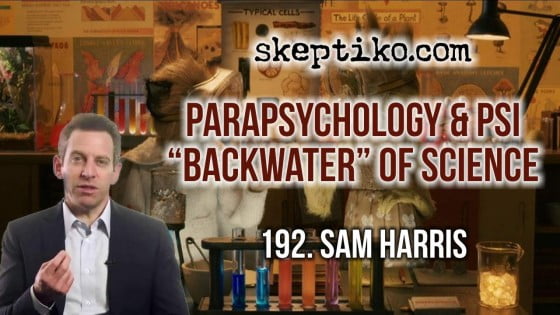
Emails from Sam Harris reveal what he really thinks about parapsychology and Psi research. Join Skeptiko host Alex Tsakiris for a discussion...

Interviews with psychologist and author and Dr. Kirby Surprise explores whether or not synchronicity is real. Join Skeptiko host Alex Tsakiris and...

Interviews Alexander Moreira-Almeida, Erlendur Haraldsson, Robert Almeder, and Stanley Krippner discuss the relationship between mind and body,...
Interview examines new methodology for estimating probability of psi and paranormal experiences. Join Skeptiko host Alex Tsakiris for an...

https://www.youtube.com/watch?v=ZBd-3T8gWnQ One researcher's creative experiment reveals a surprising link between synchronicity, spirituality and the paranormal. Join Skeptiko host Alex Tsakiris for an interview with Robert Perry, author of, Signs: A New Approach to Coincidence, Synchronicity, Guidance, Life Purpose, and God's Plan. During the interview Perry explains his research: Robert Perry: CMPE which stands for a Conjunction of Meaningfully Parallel Events. It’s basically an extreme form of synchronicity. Most of our paranormal events that we’re studying now, they’re inner experiences with hopefully a veridical component but in the end they seem to say something about our abilities or our ultimate nature being perhaps immaterial. But with CMPEs their statement seems to be more about something other than us that seems to giving us messages. Alex Tsakiris: I’m just not quite sure that we can make that last leap because there’s this whole idea of time and that maybe time is not linear. But also in terms of you and I being co-creators of our reality. So we get back to this idea of what’s reality and how is reality being created and experienced and again, what’s our relationship to time? Robert Perry: We shouldn’t act like anything is substantive yet however I think that there is a contemporary bias, even among those of us who are into the paranormal; a bias against sort of agents that are beyond the human. Maybe, if we take NDEs seriously for instance, it looks like that experience involves a certain amount of initiative from the Other Side. Maybe something coming to the human level from the Other Side is part of how life works. Robert Perry's Website Click here for YouTube version Click here for forum discussion Play It: Download MP3 (44 min.) Read It: Alex Tsakiris: Today we welcome back to Skeptiko Robert Perry. Robert’s here to talk about his book, Signs: A New Approach to Coincidence, Synchronicity, Guidance, Life Purpose, and God’s Plan. He’s also here to tell us about a pilot study he’s done about this work along with Dr. Bruce Greyson that is suggestive that he really is onto something here. So Robert, thank you for joining me. Welcome back. Robert Perry: Oh, it’s a great pleasure and I’m very honored to be here. I love the show and listen every week.
...Parapsychology researcher from Iceland explores the past life memories of children. Join Skeptiko guest host and paranormal dream expert Andy...
Interview with Cornell University Professor Emeritus Dr. Daryl Bem looks at the reaction to his groundbreaking parapsychology experiments. Join Skeptiko host Alex Tsakiris for an interview with noted psychology professor Dr. Daryl Bem. During the interview Bem discusses the reaction to his research among parapsychology opponents: Alex Tsakiris: What do you think is going to happen with this latest round of debunking? The skeptics have risen up and it seems like a very well-organized, concerted effort to knock down your research. What do you think their game plan is? What do you think is going to happen? Dr. Daryl Bem: Well, I think the flurry of activity in the popular media will just sort of die down. When I look at Google News on it there are still four or five articles that pop up in which it just shows how successful Wiseman is at getting his point of view out. I have been replying to people who’ve asked me to reply to blogs and things of that sort. Without accusing him of actually being dishonest, he has now published the three studies that he and French and Ritchie tried to get published in several journals that rejected it. I replied with a comment on that. If there’s anything dishonest there, it’s when you publish an article, even if it’s of your own three experiments—they did three experiments that failed trying to replicate one of my experiments—you always have a literature review section where you talk about all the previous research and known research on the topic before you present your own data. What Wiseman never tells people is in Ritchie, Wiseman and French is that his online registry where he asked everyone to register, first of all he provided a deadline date. I don’t know of any serious researcher working on their own stuff who is going to drop everything and immediately do a replication... anyway, he and Ritchie and French published these three studies. Well, they knew that there were three other studies that had been submitted and completed and two of the three showed statistically significant results replicating my results. But you don’t know that from reading his article. That borders on dishonesty. Dr. Daryl Bem's Website Play It: Download MP3 (45 min.) Read It: Today we welcome Dr. Daryl Bem to Skeptiko. Dr. Bem is a very highly regarded social psychologist and Professor Emeritus from Cornell who created quite a stir last year with his paper, “Feeling the Future: Experimental Evidence for Anomalous Retroactive Influences on Cognition and Affect.” Alex Tsakiris: Dr. Bem, it’s a great pleasure to have you on Skeptiko. Thanks for joining me. Dr. Daryl Bem: Good to be here.
...Interview with Rollins College professor of philosophy examines what parapsychology research in other cultures tells us about consciousness. Join...
Psychotherapist and Medium claims communication with spirits reveals no reincarnation. Join Skeptiko host Alex Tsakiris for an interview with August Goforth, author of The Risen. During the interview Goforth discusses his beliefs about reincarnation: Alex Tsakiris: You said that through your communication with on the other side that reincarnation isn’t a core part of the overall spiritual plan. Could you be wrong? August Goforth: I have a huge library of books written by mediums and spiritualists that go back almost a couple hundred years. I noticed not a single one mentioned reincarnation. Alex Tsakiris: I’ve spoken to plenty of mediums and many of them have talked matter-of-factly about reincarnation as being a reality. And I’m a little bit familiar with some of the medium literature out there, and I think the idea of reincarnation comes up quite a bit. August Goforth: It does now. It’s only been maybe in the past 10 years. I would also suggest that it’s a function of the ego-mind that invents these ideas about reincarnation because of its fear of losing its own consciousness. I may have these dreams or these feelings about an experience of being someone from the 14th Century and I get names and I get all kinds of facts and dates and rather than separating myself from it, there’s something about me--the ego-mind will do this, it will grab onto it and sort of put it on like a costume and say, “Okay, this is me. I’m having a past-life experience.” Me not realizing consciously that I just experienced someone else’s life and they told me about their life in a dream or an astral experience. When I woke up, somehow it became very blurred and I had this desire because I don’t want to die, I want to live on, that if I can convince myself that I had these past lives that gives me a sense of continuity. It gives me a sense of feeling alive and grounded. I feel more expanded. Alex Tsakiris: For reincarnation the best scientific work—and I’m sure you’re familiar with it—is the work of Ian Stevenson at the University of Virginia and now Jim Tucker at the University of Virginia has followed up on this work. They have thousands at this point of cases of well-documented reincarnation accounts. It’s quite a body of research; it’s very impressive to anyone who looks at it. So I can listen to what you’re saying and I can be open to hearing it, but how do we resolve that? How do we resolve that when it brushes against what I think is some good, down-to-earth science that I can really lay my hands on? August Goforth: I don’t know. These are just suggestions of how I’m interpreting what information has come to me as best as I can. My bias, if any, is that I’m not interested myself in reincarnation and God – no – I don’t want to come back to this place. But there are people who do or have a belief. It’s a core belief in some way or it’s necessary. But it seems more and more to me that everyone’s experience, whatever it is, is ultimately their own final test of what’s true for them. The Risen Website Play It: Download MP3 (29:00 min.) Read It: Alex Tsakiris: What Skeptiko is about is really three things. First, it’s about understanding the overwhelming scientific evidence that consciousness survives death. So if you just, from a science standpoint, if you look medically people die. They are brought back to life. And they have these incredible encounters with what happened when they had no brain, which means they were dead. August Goforth: About the survival of consciousness, yeah.
...Lucid dreaming expert Robert Waggoner explains how to become aware of our dreams while we’re dreaming, and how paranormal dreams can lead to a journey of self-discovery. Join Skeptiko host Alex Tsakiris for an interview with author, and lucid dream expert, Robert Waggoner. During the interview Waggoner explains how paranormal dreams can reveal future events: Andrew Paquette: Can you give an example of something like that where you’ve been in a dream and you’ve asked for some kind of future information, you’ve been given it, and later on in a waking state you were able to verify this? Robert Waggoner: Sure. One time a good friend of mine asked me if I’d ever sought out the lottery numbers while lucid dreaming. That had never occurred to me and I asked him if he had. He said, “Oh yeah,” and he told me what happened. He said he became consciously aware and that he asked for the numbers of the MegaLotto or whatever it was called in his state, to appear when he opened up something. So he opened up a book or something, and he saw six sets of two numbers. And during the lucid dream he was really excited and he started to memorize them as quickly as he could. So there’s the first number, 26 and the next number is 3 and the next number is 17. And it goes on and on. He said he was really working hard to memorize the set of six two-digit numbers. When he woke up from the lucid dream he immediately reached for his dream journal and began writing them down as quickly as possible. He says he got the first three exactly right but from then on his memory failed him. He just couldn’t recall the exact order. So a week later when the MegaLotto happened, he said he got the first three exactly right but then the other ones, the order had been goofed up. He’d transposed the numbers as anyone might. Robert Waggoner's Website Play It: Download MP3 (47:00 min.) Read It: Andrew Paquette: Tonight we welcome Robert Waggoner, author of the book, Lucid Dreaming and a frequent speaker on the subject of lucid dreams. Welcome to the Skeptiko program, Mr. Waggoner. Robert Waggoner: Thanks, Andrew; I’m happy to be here.
...OBE expert Graham Nicholls explains how his out of body experiences have led him to an understanding of the spiritual. Join Skeptiko host Alex Tsakiris for an interview with Graham Nicholls author of, Avenues of the Human Spirit. During the interview Nicholls discusses why his OBEs have not led him to a belief in God: Alex Tsakiris: On one hand you’re saying being good is the ultimate truth, on the other hand you’re saying being good doesn’t matter. Graham Nicholls: But if we’re talking about this spiritual awareness that I’ve been talking about, then there isn’t a separation. There would be no selfish statement that you’re making. There would be no, “ this is to my benefit.” Alex Tsakiris: Then there’d be no compassionate statement either. That’s the problem with words like “selflessness”, the can only take us so far in these kinds of discussions. Should we be good? Is there a moral imperative to be good? This is what the near-death experience research tells us. NDErs say there is this moral directive. You can deny that, and you can say that’s not your reality, but that’s what you’re debating against. Graham Nicholls: I am saying that’s my reality. I’m saying for me compassion and those things have fallen out of this interconnectedness, this sense of oneness, which is exactly what you’re describing. This sense of love and all those things. But like I said, “good” is not really a word that I’m comfortable with. I’m talking more about this sense of growth, nurturing, of why would we do something to harm the ultimate progression of ourselves? Or, of our reality? That is more where I’m coming from. There doesn’t need to be a higher God. Graham Nicholls's Website Play it: Download MP3 (57:00 min.) Read it: Alex Tsakiris: Today we welcome Graham Nicholls to Skeptiko. Graham is the author of Avenues of the Human Spirit. He’s an accomplished OBE experiencer. He’s had many out-of-body experiences that he talks about in the book. I’ve known Graham for quite some time and was introduced to him by Rupert Sheldrake. Then about a year ago, I wound up taking an online course on out-of-body experiences from Graham. So it’s a great pleasure to welcome you on Skeptiko, Graham. Graham Nicholls: Thanks, Alex, it’s great to be here. Alex Tsakiris: So this book that you’ve written, Avenues of the Human Spirit, that has been a while in the making but is now out and available on Amazon, is a very personal book about your journey spiritually and how OBEs play into that.
...Professor of Psychology and well-respected researcher Dr. Stanley Krippner explains how his research supports the reality of precognitive dreams. Join Skeptiko guest host and paranormal dream expert Andy Paquette for an interview with legendary psychology researcher Dr. Stanley Krippner.. During the interview Dr. Krippner discusses whether or not the evidence for paranormal dreaming is well established: Andy Paquette: You’ve been studying dreams for the most part for the majority of your career. Do you feel that the case for precognitive dreaming is proven? Dr. Stanley Krippner: No, I don’t think anything in science is proven. Science is always open-ended. There’s always a chance of revising scientific theory based on new data. Andy Paquette: Of course, that would work both ways, as well, wouldn’t it? So what you’d really be talking about is what does the currently available information indicate? Dr. Stanley Krippner: That’s right. Andy Paquette: And in your case, from what you’ve seen, what do you think the currently available information indicates? Dr. Stanley Krippner: I think you can make a strong case for precognitive dreams. Stanley Krippner's Website Play it: Download MP3 (35:00 min.) Read it: Alex Tsakiris: Today we’re joined by Andy Paquette, who is a former Skeptiko guest and is also the author of Dreamer: 20 Years of Psychic Dreams and How They Changed My Life. Now, Andy is joining us today because he recently attended the 2011 Study of Dreams Conference in The Netherlands, where he was also a presenter. While he was there he was nice enough to snag a couple of interviews for us and he’s here to share them with us. So Andy, welcome and tell us what you’ve been up to.
...Author of The Bond explains how our scientific understanding of human connection leads to spirituality. Join Skeptiko host Alex Tsakiris for an interview with Lynne McTaggart best-selling author of, The Bond. During the interview Ms. Mc Taggart discusses how science can give us a greater understanding of the spiritual: Alex Tsakiris: On Skeptiko we’ve found that a deep examination of many of scientific questions quickly leads to questions of the spiritual. Questions of God, questions of the afterlife, questions about the meaning of consciousness. You don’t seem to go there very much. Why not? Lynne McTaggart: Because I wanted to argue in terms of science. I wanted to say we’re operating against nature. We’re operating against science, emerging science that is coming to the fore. I believe the science—I always look at scientific elements and I sit probably where science and spirituality meet because the science that I write about is very spiritual in a way. If you want to look at it this way, I’m just simply looking at it from the point of view of saying we’ve been living against nature. We’ve been living according to the wrong story and that’s why we’re in the mess we’re in. Alex Tsakiris: When we enter into the materialistic, atheistic, science game that’s been dictated and then we find that it no longer holds together, I think it behooves us to take a step back and re-examine things. For example, you make a good case for the science interconnectedness, not just at a subatomic level, but at a level we can feel and experience. Don’t we then need to look our great wisdom traditions and notice that they’ve been saying the same thing all along? Lynne McTaggart: I think that’s what my books try to do all the time. They just provide the scientific basis for what spiritual traditions have been saying for centuries. In a sense, my books are always the science of religion. And yes, we have to understand. You have to take it back to the whole idea of unity infusing everything that we are and everything that we do. That’s a very spiritual idea. Lynne Mc Taggart's Website www.thebond.net Play it: Download MP3 (40:00 min.) Read it: Alex Tsakiris: Today we welcome journalist, part-time consciousness researcher, and multiple best-selling author, Lynne McTaggart to Skeptiko. Lynne, thanks so much for joining me today.
...Noted parapsychology investigator and author Guy Lyon Playfair discusses poltergeists, after-death communication and the telepathy of twins. Join Skeptiko guest host Steve Volk for an interview with Guy Lyon Playfair. During the interview Mr. Playfair summarizes what he’s learned about the poltergeist phenomena: Steve Volk: What’s your best guess, at this stage, after all these years, on what poltergeists, or ghosts, are. Guy Playfair: The short answer is that there are two possibilities. Either they are some kind of discarnate entity – which I certainly don’t rule out – or else they are an entirely unknown force that emanates from the human mind. How it works we simply don’t know. We can only observe its effects. I think there’s quite strong evidence that it’s some kind of so-called spirit or discarnate entity, kind of drifting blobs of exo-intelligence, if you like. But that is an extremely controversial opinion and not many people share it. Steve Volk: I do find it interesting that in some cases skeptics have started putting forth more complicated and I would say more interesting theories than the usual, the mind plays tricks, wishful thinking, creaking floorboards, leaky pipes kind of explanations. Guy Playfair: Yes, there’s another possible line of inquiry. Poltergeist outbreaks have got certain features in common with Tourette’s syndrome, where you get these sorts of jerks and muscular spasms and things and also very strange vocal sounds. A poltergeist looks rather like an extension of some super-Tourette’s where not only the muscles twitch but furniture starts twitching as well. But that’s not my idea. That was actually Michael Persinger and William Roll, who is a very experienced researcher. I think it’s an interesting line to follow up. Guy Lyon Playfair's wiki entry Play it: Download MP3 (33:00 min.) Read it: I’m Steve Volk, guest hosting for Alex Tsakiris on Skeptiko. My guest today is Guy Lyon Playfair, a journalist and translator who has been conducting paranormal research seemingly forever. His first book, The Unknown Power, a book on psychical research, was written in 1975. In the ensuing years he’s written about Uri Geller, hypnotism, telepathy among twins, reincarnation, and we’ll discuss some of those things. Today we’re going to focus out of the gate on the topic of Guy’s new book, a re-release really, of a book first published in 1980. The book is called, This House Is Haunted, and it deals with the very famous Enfield Poltergeist case. I wanted to talk to Guy because in my book, Fringe-ology, I kind of out myself, describing what I call “the family ghost,” an old ghost story I grew up with as a child. I was about six years old and have a few memories of the events my family’s described to me. In general, without getting into too much detail, there was a booming and thumping sound that came from the walls and ceiling. It seemed to respond to my parents’ movements in the house. My sisters talked about having the blankets pulled from them as they slept, their beds shaking in unison in the middle of the night, and a female apparition who walked through the room. I’m hoping Guy, in talking about the Enfield case, can give me a little insight into poltergeists, including some details from a new study which used some recordings from the Enfield case, conducted by Dr. Barrie Colvin, with whom Guy cooperated. Hopefully we will get to much else besides. Guy, thanks for being on Skeptiko. Guy Playfair: Thank you for having me.
...Biologist and author Rupert Sheldrake expresses dismay at latest claims made by Skeptic Richard Wiseman in his recent book, Paranormality.
Pulitzer Prize winning author Deborah Blum discusses the challenges of science reporting and the paranormal taboo. Skeptiko guest host Steve Volk welcomes Deborah Blum author of, Ghost Hunters - William James and the Hunt for Scientific Proof of Life After Death. During the interview Ms. Blum discusses her approach to covering the paranormal: Steve Volk: This is one of the hardest things. Who do we believe? Who do we trust? I want to see somehow people in the middle pick this stuff up and look at it, but that's a very, very rare occurrence. Deborah Blum: I agree. Like I said, I'm a mainstream science journalist and daughter of a chemist. But what was fascinating to me when I started working on Ghost Hunters is that I'd go and give talks at different universities. I mean literally, I was at the University of Florida and they said, 'Oh, let us tell you about our haunted laboratory.' Or I was at a meeting with a bunch of animal researchers and I was sitting next to a very respected scientist from Stanford who immediately started telling me about the telepathic experiences she'd had with a friend of hers who is a scientist at Southwestern University. I thought to myself, 'This whole world exists that really those of us in the skeptic/science community never see because people just don't tell you about it. Steve Volks's website Fringe-ology Trailer Deborah Blum - Ghost Hunters Play it: Download MP3 (58:00 min.) Read it: Welcome to Skeptiko, where we explore controversial science with leading researchers, thinkers, and their critics. I'm your host, Alex Tsakiris. On this episode, as you just heard, there's a new voice behind the interview so before we get started I thought we'd take a minute and introduce that voice, that being the voice of journalist and author, Steve Volk, who's joining me right now.
...The author of, Dreamer: 20 Years of Psychic Dreams and How They Changed My Life, discusses his psychic and precognitive experiences. Join Skeptiko host Alex Tsakiris for an interview discussing precognition and the psychic dreams of author Andy Paquette. During the interview Mr. Paquette discusses the differences between real life precognition expereinces and labratorty experiments on ESP like those of Dr. Daryl Bem, "Well, the funny thing about asking me a question like that is that while I am aware of some of those things, I became aware of them after I already knew that precognition happens because it happened to me in much more dramatic ways than was ever recorded in the lab. On the other hand, the reason he is studying it in the first place is because there are people like me who've had more dramatic examples of precognition. We've recorded them or passed them on to other people and this eventually makes researchers curious." Paquette continues, "Now the problem with testing in the lab as I see it, is that you're trying to duplicate an effect that has a very specific reason for coming into being without knowing what that reason is and without having any way to recreate those conditions because you don't understand the reason to begin with. This, in my mind, is the reason why laboratory results tend to be very weak. It's because they're not really duplicating the right circumstances that cause these kinds of things to happen. So what happens is they kind of nick the edge of this thing that they're researching, and even that little tiny slice they get is enough to support a hypothesis of precognition. However, it's not as dramatic as the kind of real-life, spontaneous examples such as the ones that occurred with me." Visit Andy's website Help pilot Dr. Rupert Sheldrake's telepathyexperiment.com Play it: Download MP3 (31:00 min.) Read it: Welcome to Skeptiko, where we explore controversial science with leading researchers, thinkers, and their critics. I'm your host, Alex Tsakiris. Before we get started with today's interview I just want to make a quick little announcement here. Dr. Rupert Sheldrake, whom many of you know through his work, his many books, his very interesting website, and his appearance on the Skeptiko show, is launching a telephone telepathy experiment here, available in the U.S. and Canada. He's looking for some folks to help him pilot this study.
...Interview with Dr. Stephen Braude reveals challenges and opportunities of controversial psi research into mediumship and psychokinesis. Research into controversial topics like psychic mediums is tough, but some researchers find it’s made even tougher when skeptics favor the weakest cases over the strongest. Join Skeptiko host Alex Tsakiris for and interview with Professor of Philosophy and psi researcher, Dr. Stephen Braude. During the interview Dr. Braude recounts his entree into psi research, “… there was all this other stuff that had been happening outside the lab from séances and anecdotal reports and I figured if I was an honest intellect I at least needed to become acquainted with it before I rejected it summarily. So I first studied the evidence for large-scale, and physical mediumship in particular. That was a momentous event because the evidence blew me away… I discovered that the evidence was much cleaner than people made it out to be.” Braude continues, “The usual arguments about the evidence being easily dismissed because of poor observation or poor conditions of observation demonstrated really a lack of command of the evidence. One of the things that struck me was that people were dismissing the non-experimental evidence by appealing to the sleaziest of arguments. They would focus on the weakest pieces of evidence and then generalize from that, which is simply straw man reasoning. The principle on which I operated all along is that the cases that matter from outside the lab have to be the strongest cases, the ones that are the hardest to explain away.” Dr. Stephen Braude Adam Curry at Psyleron, a company that explores the connection between the mind and the physical world. Update from Dr. Sam Parnia Play it: Download MP3 (31:00 min.) Read it: Adam Curry: So Steve, can you give me a little capsule about who you are?
...Interviews with Tamas Borbely of Goldsmiths College and Dr. Peter Bancel of the Global Consciousness Project reveal common ground on revolutionary research. The notion of a collective global consciousness is accepted truth within many cultures, but scoffed at by modern scientists. That may change. Once skeptical researchers investigating the 10-year Global Consciousness Project are finding solid data to support the conclusion that we're all connected. Join Skeptiko host Alex Tsakiris an interview with Tamas Boberly of Goldsmiths College at the University of London, and Dr. Peter Bancel of the Global Consciousness Project. During the 50-minute interview Mr. Boberly recaps his analysis of the work done so far, "I've been reading the papers that Dr. Nelson and others produced on the Global Consciousness Project and it is my impression that they have a very, very solid methodology and a very good grasp of the statistics that are used... and if you look at the results, obviously the results they report are astronomical. They are very, very convincing. I think the only criticism, which is perhaps even unjust, could come in the form of claiming that because of the lack of a clear-cut definition for these events, perhaps not all, the negative results are reported. And like I said, I'm not suggesting that this is the case. But defining the events in advance would be an excellent way of silencing critics, because otherwise, having looked at the database that they have compiled in the past decade or more, it is certainly very convincing." Dr. Peter Bancel describes his involvement with the project, "I came into the project after it had been going for a couple of years and even at that point the cumulative effect of these events that Roger Nelson had been looking at had considerable significance. So one of the first things I set out to do was to see if I could find something methodological or otherwise wrong in how the project was set up. I was asking myself if there was anything fatal, and there wasn't at all." Play it: Download MP3 (50:20 min.) Read it: Alex Tsakiris: We're joined today by Tamas Borbely, who is a research assistant at Goldsmiths College at the University of London. Tamas is one of the researchers that Chris French has tasked with looking into the Global Consciousness Project and doing a little bit of collaborative work and making an attempt to see if any of that research makes sense or needs further analysis. So with kind of a stumbling introduction, Tamas, welcome to Skeptiko. Tamas Borbely: Hello, Alex.
...Professor at University of Colorado's Department of Electrical and Computer Engineering guides students through experiments demonstrating unexplainable psychic phenomena. With a stellar academic and professional background Dr. Garret Moddel had little to gain by venturing into controversial research on psychic phenomena. But for a professor who long ago tackled quantum engineering cutting edge research comes naturally. Join Skeptiko host Alex Tsakiris for an interview with University of Colorado engineering professor Dr, Garret Moddel. During the 40-minute interview Dr. Moddel describes the challenges of bringing controversial research into the classroom, "I spent most of my career doing essentially quantum engineering, which is engineering little devices based upon quantum mechanical principles. Then about ten years ago on Sabbatical, I got in contact by accident with a physicist who had a library full of books on the science of psychic phenomena. I was absolutely blown away. I couldn't believe what I saw. I ended up spending the whole Sabbatical going through his library. After that, I was convinced that this is really where the new science and revolutionary ideas are going to come from, so I still continue my mainstream research and most of my colleagues don't know about my psi phenomena research, although it is on my website. I think they choose not to know." Dr. Moddel's students learn about the science behind these strange phenomena and prove to themselves that they exist, "the course goes through the history of psi research and we use different textbooks depending on the time. Right now the two textbooks that I'm using are Dean Radin's Entangled Minds, which is just a wonderful, wonderful book describing psi research and then also Chris Carter's book on Parapsychology and the Skeptics, which takes a wonderful philosophical view of all of this and puts it in perspective. Then each student or each group of students must carry out an independent psi research project. This has to be high quality research. It's got to be publishable quality research. Half the grade depends upon it. And they take it quite seriously. They come up with very creative experiments." The Society for Scientific Exploration (SSE) is a professional organization of scientists and scholars who study unusual and unexplained phenomena. Subjects often cross mainstream boundaries, such as consciousness, ufos, and alternative medicine, yet often have profound implications for human knowledge and technology. Play it: Download MP3 (43:30 min.) Read it: Alex Tsakiris: Let me give you some of the highlights from the Curriculum Vitae of today's guest. Let's start with electrical engineering degree from Stanford, master's and PhD in applied physics from Harvard, professor at University of Colorado, former CEO of a venture-backed high technology start-up. And on top of all that, President of the Society for Scientific Exploration.
...