A critical look at an academic near-death experience book by Dr. Ben Mitchell-Yellin and Dr. John Martin Fischer. photo by: Iwan Gabovitch It's...


Skeptiko – The Interview Archive Behind Future of Inquiry
Long-form conversations on consciousness, science, spirituality, skepticism, AI, and contested evidence.





the scientific study of near-death experiences.
A critical look at an academic near-death experience book by Dr. Ben Mitchell-Yellin and Dr. John Martin Fischer. photo by: Iwan Gabovitch It's...

This physician discovered near-death experience science can help those experiencing grief. photo by: Martin Today we welcome Dr. Piero...

The International Association for Near Death Studies (IANDS) claims their association with Eckankar is not different from other religious groups. ...

Near-Death Experience Research, Dr. Jan Holden and her colleagues reveal their latest findings. photo by: Steve Jurvetson The question might sound...

Recent study of near-death experience survivors flies in the face of neuroscience's assertion about NDEs. photo by Carl A According to science's...

As a philosopher, Dr. Evan Thompson thinks neuroscience model of near-death experience is fine, but what do NDE researchers say? Debate over the...

Interview with Dr. Alan Hugenot about the future of near-death experience research. Controversy brewing. Interview with Dr. Alan Hugenot a...

Interview with religious scholar Dr. Gregory Shushan on the parallels between near-death experience accounts across cultures. Join Skeptiko host...

Interview with Ian McCormack about his exclusively Christian interpretation of near-death experiences. Join Skeptiko host Alex Tsakiris for an...
Interview with Pastor Howard Storm about his transformation from atheism by way of near-death experience. Join Skeptiko host Alex Tsakiris for an...

Click here for YouTube version Click here for forum discussion Interview with the author of, Don't Worry! There Probably is an Afterlife looks at...

Click here for YouTube version Click here for forum discussion Click here to post comments on AlexTsakiris.com Interview with Kevin Williams creator of one of the leading website portals on Near-Death Experience science. Today we welcome Kevin Williams to Skeptiko. Kevin is the creator of www.near-death.com, the #1 website on near-death experiences, both in terms of visitor traffic and in terms of the comprehensive amount of information about near-death experiences, near-death research, and all topics related to this amazing phenomena. Kevin is also the author of Nothing Better Than Death: Insights from 62 Profound Near-Death Experiences. Kevin, welcome to Skeptiko. Thanks so much for joining me. Kevin Williams: Thank you, Alex. It’s my pleasure. Alex Tsakiris: So as I just mentioned, near-death.com is amazingly comprehensive. It pops up on virtually hundreds if not thousands of different search terms. Even if they’re not familiar with the website, people have probably encountered it. Start us off from the beginning. Tell us how you started it, why you started it, and the driving force behind it. Kevin Williams: First of all, I’m a big believer in synchronicity and it seems like most of my life I’ve had that. When I was a kid, my dad had a small CRT screen and for some reason I knew that I could build it so that people could ask questions to it and get answers back. I just had that in my mind for a long time. I don’t know why. Then when I went to college and got into computer science, I graduated just about the time when the Internet was taking off. Before that time I read Raymond Moody’s book, Life After Life. That was the late ‘70s. Since then I couldn’t get enough books to read on the subject. It was kind of a synchronistic time that I just happened to learn how to build websites at a time when I was fully knowledgeable about near-death experiences and a time when I was able to build a website. I started really early. Part of the reason why I get a lot of hits on different keywords is because I designed my website as a portal, which means that there are usually only two or three levels deep in my website. I built it that way specifically so that it would do that. It has the ability to access a lot of information right upfront and also it would be a lot easier to navigate. (continued below) Play It Listen Now: Download MP3 (44 min.) Read It: (continued...) Alex Tsakiris: So you did not have a near-death experience prior to starting this, is that right? Kevin Williams: Yes, that’s true. I’ve never had a near-death experience. But once you read enough of them you almost feel like this is information that you’ve known before. In fact, a lot of near-death experiencers, during their experience they’ll receive knowledge like that, forgotten knowledge. The more I read about it, the more I realized that this was true for me and that everybody has actually experienced death many times through reincarnation. So that was part of it right there.
...
Click here for YouTube version Click here for forum discussion Click here to post comments on AlexTsakiris.com Examination of recent research from the University of Michigan linking surge in brain activity of dying rats to near-death experience science. Join Skeptiko host Alex Tsakiris for a look at two interviews that shed light on recent reports suggesting a scientific explanation for near-death experiences has been discovered in the work of Dr. Jimo Borjigin, at the University of Michigan. The study found a surge in electrical activity in the brains of dying rats. Researcher and science writers offered this as a possible expatiation for human near-death experiences. As we’ve seen in the past, research supporting a convention explanation for near-death experience receives considerable attention form the mainstream science media. This study was no exception with stories popping up on the BBC, ABC, CBS, FOX, National Geographic and many other media outlets. (continued below) NPR's report on the research Play It Listen Now: Download MP3 (43 min.) Read It: Many Skeptiko listeners sent me this links to the various reports on this research, and I kept pointing them to a past interview I had done a couple of years ago relating to this topic, but since I never mentioned it on the show I thought I do so now. In June of 2011 I interviewed George Washington University Medical Center Professor, Dr. Lakhmir Chawla, who discovered a surge in the brain’s electrical activity seconds before death might in humans. Here’s a clip from Skeptiko episode 140: --------- Alex Tsakiris: So, Dr. Chawla, in 2009 you published a paper with the surprising discovery that some of your patients who were very close to death experienced a final surge in brain activity and the paper has gained quite a bit of traction, media attention, mainly because of this quote of yours: “We think that near-death experiences could be caused by a surge of electrical energy as the brain runs out of oxygen.” It‘s been a while since that paper was published. So first I want to ask you, do you still think that what you saw has anything to do with near-death experience? Dr. Lakhmir Chawla: Obviously all of the patients in our study passed away so there’s really no way for us to truly know if what these people were experiencing is, in fact had they survived, being the signature of a near-death experience. What we did notice which was very striking is that in all these patients--and in this study we reported on seven patients on which we had very good documentation. We’ve seen these electrical surges, EEG activity, at the end of life in over 100 patients and what we basically have, I hypothesize that when people pass away something occurs in their neural structure. We have a hypothesis for why this may be happening, that causes this large intensity of electrical energy. What we basically hypothesize further and speculate is that if somebody within the field, someone who’s having a heart attack, for example, and their heart stops and the oxygen to their brain went down and they have this sort of terminal surge of energy and then they were resuscitated and brought back, it’s very likely that they would recall that electrical surge. If they did recall that electrical surge, we hypothesize and speculate that that could be what people describe in their near-death experiences. The one thing that we’ve seen rather consistently when you read the literature of near-death experiences is that not everyone has the same imagery. Not everyone has the same experience. But the one thing that they all have in common is that the experience is very intense and very vivid. People can usually recall many, many years later on with great detail what they experienced. So it would take something that would be a very durable electrical event of energy for someone to have that. So we put those notions together and arrived at that speculation. Alex Tsakiris: Okay. I just wanted to confirm that and it’s interesting that you reference the near-death experience literature. I’ve had a chance to interview some of the world’s leading near-death experience researchers and gosh, I even went back and talked to some of them about this. I couldn’t find any of them that would even seriously entertain that kind of speculation. As a matter of fact, privately one of them told me, and this is pretty harsh, but he said, “It’s one of the dumbest explanations for near-death experience yet published.” So I guess I was really wondering exactly where you’re coming from, exactly what near-death experience research you’ve dug into that makes you feel like the speculation that you’re talking about would fit the broader research that’s been done into near-death experience. Dr. Lakhmir Chawla: No, I mean I’m not a researcher in near-death experience. That’s not my primary scientific interest. We are basically at the bedside taking care of very sick patients in the intense care unit. I don’t pretend to have any incredible insight into what these are or are not. All we are saying from our group’s scientific standpoint is that we see a very consistent signature for patients when they’re passing away. We are not the only investigators to report this; it’s now been investigated and reported by multiple investigators.
...
Interview with Robert Mays reveals a disturbing pattern of misrepresentation and distortion in Luke Dittrich's Proof of Heaven expose published in Esquire Magazine. photo by Derek K. Miller Join Skeptiko host Alex Tsakiris for an interview with Robert Mays about his recently published article, Esquire article on Eben Alexander distorts the facts. During the interview Mays talks about what his investigation discovered: Alex Tsakiris: The Dittrich article in Esquire, it's extremely well-crafted. Let's give them that. And he builds this case with the facts that he has, but he really builds this whole thing around -- this guy's a liar. He approaches it from a number of different angles, some of which are really substantive to the story like the coma thing, and these other things that he picks at, but they do kind of stick in your mind as you're reading the article. Like the rainbow thing. Tell us what the rainbow thing is all about and then tell us what you found out. Robert Mays: In the book, on Sunday morning according to the story that Dr. Alexander wrote, his sister, Phyllis, and his mother, Betty, were coming into the hospital and saw a perfect rainbow. They felt this was a sign. Dittrich took this as saying Heaven itself was heralding Eben Alexander's return. Dittrich then asked the meteorologist whether there could have been a rainbow then and the meteorologist said, “Well, the day was clear so there couldn't have been.” I said, “Well, wait a minute. Two people said they saw it.” So I called Phyllis Alexander and she said, “Definitely we saw a rainbow. Betty remarked that it was a perfect rainbow.” They talked about it. Then they went immediately up to Eben's room and there Eben was, sitting up. So that was the time that he had recovered. Alex Tsakiris: And just to add a little tidbit that you talk about in your article that I thought was great and is the real kind of journalism that we would have liked to have gotten from Esquire is that you not only talked to these eyewitnesses, which he did not--he just went on some meteorological report--but they also had evidence. It was such a spectacular event that they had written an email. Robert Mays: Right. That day Phyllis said she had written to friends in Boston who were praying for Eben. She said, “Eben has recovered and I saw a beautiful rainbow as I was coming into the hospital.” So there's that documentation, as well. So Luke Dittrich's argument there is empty. Alex Tsakiris: It's shoddy journalism. If you're trying to debunk something, which I've run across so many times, that's one thing. You're a debunker. You're just out there throwing whatever you can against the wall and seeing what sticks. But if you're Esquire, who still has some kind of legitimacy as a journalistic enterprise, you have to do more than this. You have to talk to witnesses. You have to get their side of it. I think this lays a pattern for what else we're about to talk about. (later) Alex Tsakiris: Here's what you get from Luke Dittrich's story in Esquire -- Dr. Laura Potter discredits Dr. Eben Alexander's story. It couldn't have happened the way he described. He wasn't really in a coma. He was delirious. So why don't you pick up from there, Robert? You've said you put a couple calls in to Dr. Potter at this point in the story. You haven't heard back. What happens next? Robert Mays: I received, from members of the family copies of emails that they had been sending back and forth. In that was a statement that Dr. Potter had made. Later I learned it was a statement that she had issued to a news organization. Apparently that news organization did not use it. In any case, that statement was that she was misquoted and taken out of context. So I said, “Whoa. This is really quite strange.” Alex Tsakiris: In fact, she stated that her account was misrepresented, and that she felt like the questions weren't fair. And this is backed up by what you heard from the family, right? Because the family talks to Dr. Potter and she's apologizing, saying “Gosh, I don't know how this happened.” That's what I took away from your article. Is that what you got from talking to the family? Robert Mays: Right. And basically Dr. Potter expressed to the family that she had been misrepresented and that her words were taken out of context by Luke Dittrich and that he had led her to say certain things. The question that Luke Dittrich says he posed to her I don't think is a question he actually posed to her when she said, “Yes, conscious but delirious.” It would be very interesting to see what exactly happened in that interview and just understand what she was responding to. Alex Tsakiris: I think it would be more than interesting. I think it's absolutely his responsibility, given the damage that this article has done and sought to do from the beginning. There's an added level of journalistic responsibility to get your facts right. These things being called into question this way demands that he really back up his claims. (interview transcript continued below) Robert and Suzanne Mays Website Click here for YouTube version Click here for forum discussion Commentary: Esquire article on Eben Alexander distorts the facts Read It: Today we welcome Robert Mays to Skeptiko. Robert, along with his wife, Suzanne, have been longtime researchers in the field of near-death experience and consciousness studies. They've published quite a few papers and have done presentations for both, the International Association of Near-Death Studies Conference, and the well-known Science of Consciousness Conference in Tucson, Arizona. So, anyone who's familiar with this field very well might have bumped into the work of these two very interesting and excellent near-death experience researchers. Robert is here today to talk about a new article they just published titled, “Esquire Article on Eben Alexander Distorts the Facts,” in which they tell about their investigation into the near-death experience account of Harvard neurosurgeon Eben Alexander, who last year published a blockbuster best-seller book titled, Proof of Heaven: A Neurosurgeon's Near-Death Experience and Journey Into the Afterlife. So with that I'd like to introduce you to Robert Mays. Robert, thanks so much for joining me today on Skeptiko. Robert Mays: Thank you. I'm glad to be here. Alex Tsakiris: Before we dive into this article that you've published on Dr. Eben Alexander's case and then the book and the controversy that's stirred up around that, I thought you could tell us a little bit about the research that you and Suzanne have done. In checking out your website there's a lot of stuff that you guys have published in this field. Tell us a little bit about that.
...
Interview examines whether or not near-death experience research conclusions contradict Christian doctrine of heaven and the afterlife. Join...

Interview examines a near-death experience science from a legal perspective. Join Skeptiko host Alex Tsakiris for an interview with Victor and...
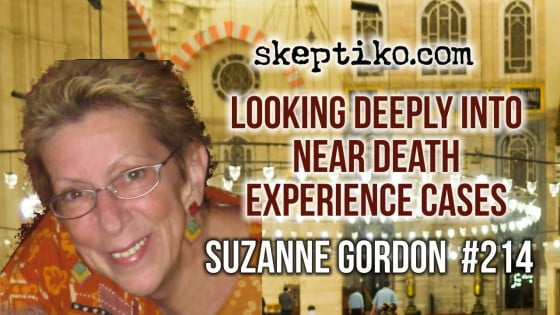
Interview brings ethnographic perspective to discover the meaning of near-death experiences to those who have had them. Join Skeptiko host Alex Tsakiris for an interview with Dr. Suzanne Gordon author of, Field Notes From the Light: An Ethnographic Study of the Meaning and Significance of Near-Death Experiences. During the interview Gordon talks about bringing Ethnography to near-death experience research: Dr. Suzanne Gordon: The interesting thing about ethnography is that it’s very time intensive. I spent a decade on the dissertation but there were two two-year periods of full-time field work. I was spending more time with people who had had near-death experiences than I was with my own family. Alex Tsakiris: Give us a sense for some of these cases. They’re just amazing. Maybe start with the Atheist. I love that one. Dr. Suzanne Gordon: Let’s start with Eric. I had everybody choose their own pseudonyms because that’s very informative. This guy chose Eric because he was a guitar player and he really liked Eric Clapton. The interesting thing to me about his account was I think it points to why it’s important for experiencers to become visible. Alex Tsakiris: Tell us about his case. Dr. Suzanne Gordon: Well, he was on the sailboat of a friend of his who was a cardiologist, conveniently enough. There was some accident and he ended up falling overboard. It was a cold day. He was burdened by clothing. He died. Then, left his body and watched the resuscitation efforts on the boat below him as he was floating away. He didn’t see God. He said, “I was very happy wherever I was going. I’m not sure where I was going but I was floating away and I was very happy to do that. I wasn’t struggling to live. I was very happy to keep going and see what happened.” They kept working on him and they’d give up periodically and then they’d work on him some more. Finally they did bring him back. He didn’t become a religious guy or anything. The only reason he even knew it was a near-death experience is because his wife had read Ray Moody’s book and pointed it out to him. He kept apologizing throughout the process. “I’m sorry. I’m just really not very interested.” I’d keep reassuring him, “I don’t care, it’s fine.” Alex Tsakiris: That’s fascinating. On the other hand, there’s a different way to read that account -- it’s the ultimate attachment to a worldview. So I’m an Atheist, I have this transformative experience, and now I know that life goes on, right? Because he does say that at the end. He goes, “Okay, I know that…” Dr. Suzanne Gordon: We go on and I didn’t know that before. Alex Tsakiris: …and I didn’t know that before, right? So that really blows apart your worldview. But I see somebody who’s not willing to go very far with that. I mean, he’s the ultimate Agnostic like I encounter so often. It’s like, well, can’t know for sure. Don’t really know. We’re kind of in the middle, versus if you look at how our culture defines life. This experience should have completely… Dr. Suzanne Gordon: Blown his mind. Alex Tsakiris: …blown his mind, and it didn’t. I wonder what thoughts you have on that in general and on this topic of personal transformation and how that’s different for different people depending on where they’re coming from. Dr. Suzanne Gordon: I think your previous experiences in life and your cultural beliefs and values are really important. I did talk about this in my dissertation but Eric had a really awful, awful childhood. Had a lot of issues. I think there are probably many, many, many more people like Eric out there that are not going to turn up to near-death studies. (continued below) Dr. Gordon's Webpage Click here for YouTube version Click here for forum discussion Link to the 2013 ACISTE conference Play It Listen Now: Download MP3 (52 min.) Read It: Today we welcome Dr. Suzanne Gordon to Skeptiko. Dr. Gordon is on the faculty at the University of Maryland and is here to talk about, among other things, her rather amazing dissertation titled, Field Notes From the Light: An Ethnographic Study of the Meaning and Significance of Near-Death Experiences. Dr. Gordon, it’s a great pleasure to welcome you to Skeptiko. Thanks so much for joining me. Dr. Suzanne Gordon: Well, I’m glad to be here, Alex. Thanks for inviting me.
...
Interview with author Chris Carter explores the scientific evidence for the survival of consciousness. Join Skeptiko host Alex Tsakiris for an interview with Chris Carter author of, Science and the Afterlife Experience: Evidence for the Immortality of Consciousness. During the interview Carter discusses the consequences of accepting scientific proof of an afterlife: Alex Tsakiris: Are there unintended consequences for overthrowing materialism? Maybe the game is going to wind up being played one way or another. We’re going to wind up with scientific materialism or Church rule. Someone has made the decision that at the end of the day I choose the phony scientific materialism over the thin, phony Church state. Chris Carter: I think that’s a false dichotomy. I don’t think that’s the choice. One of the major themes of my book is that there’s a third alternative, one that does not require a leap of faith and one that does not require embracing the pseudo-scientific ideology of materialism. There’s a third alternative and it is to examine the evidence without prejudice, without materialistic prejudice or religious prejudice, and see what the evidence says. I believe that the conclusions that the evidence implies are not dogmatic. They do not ask people to go out and burn those who disagree with us at the stake or to wage war against those who disagree with us. Chris Carter's Website Cynthia's Book: Belief Is So Last Century Click here for YouTube version Click here for forum discussion Play It: Listen Now: Download MP3 (58 min.) Read It: Today we welcome Chris Carter back to Skeptiko. Many of you know Chris for his withering attacks on skeptical nonsense and his books, Science and the Near-Death Experience, Science and Psychic Phenomena, and his latest, Science and the Afterlife Experience. Chris holds undergraduate and Master’s degrees in philosophy from Oxford. He’s a very fine writer, and it’s a pleasure to welcome him back to Skeptiko. Chris, welcome back. Thanks for joining me. Chris Carter: Thanks, Alex. How are you doing? Alex Tsakiris: Great. Everything’s good. This latest book is really fascinating. It’s obviously a topic that we love to talk about here. You really dig into so much. I’m hoping we can talk about the book but also talk about a lot of other things surrounding the book. I’m anxious to have you back on.
...
Interview with Dr. Victor Stenger about his new book, God and the Folly of Faith, and the science of consciousness and near-death experience. Join Skeptiko host Alex Tsakiris for an interview with physicist, Atheist and author Dr. Victor Stenger about his new book, God and the Folly of Faith: The Incompatibility of Science and Religion. During the interview Stenger explains why he believes many parapsychologists, consciousness researchers and near-death experience researchers are charlatans: Alex Tsakiris: As you mentioned, Stuart Hameroff is an anesthesiologist, so he may be crossing disciplines, but he’s also publishing with a Nobel Prize winner and some of the top people in the field. But let’s move on from that a little bit because what I really wanted to get to with that is what is at stake for Atheism with this idea of consciousness being more than materialism? Mind being just the brain? Dr. Victor Stenger: All the Atheists I know, that is those who are scientists and really understand the scientific method, will say, “You show me the evidence for something beyond matter, then we’ll believe it.” So we’re open to that. It’s not so much that we have any particular stake other than the stake of determining the truth as best as we can. And that’s the problem. These people are charlatans to be claiming that there’s evidence for a quantum aspect of the mind. That’s just not true. Maybe they’ll find one someday. We’re open to that. But they just do not have the data to support that and they don’t have the theory to support that. And that’s the thing that’s so upsetting about it because they’re able to get away with this because they’re talking to audiences who are not aware of the science, who really don’t know the science. Alex Tsakiris: You’re not saying Christof Koch is a charlatan? Or Stuart Hameroff is a charlatan? I assume, right? So who are the charlatans? Dr. Victor Stenger: I know that I know Stanley Krippner, I know some of the other people that are on the list of people you’ve interviewed in the past. I saw your list and I’ll tell you they’re not part of any mainstream that I know of. Alex Tsakiris: So do you think Stanley Krippner is a charlatan? Dr. Victor Stenger: Absolutely. Victor Stenger's Website Click here for YouTube version Click here for forum discussion Play It: Listen Now: Download MP3 (52 min.) Read It: Today we welcome Dr. Victor Stenger to Skeptiko. Dr. Stenger is an adjunct Professor of Philosophy at the University of Colorado but that’s really a second academic career for him. He’s also Professor Emeritus in Physics and Astronomy for the University of Hawaii. He’s also a very successful author, having published 11 books including the 2007 New York Times Bestseller, God: The Failed Hypothesis. How Science Shows That God Does Not Exist, and his latest book, God and the Folly of Faith. Welcome to Skeptiko, Vic. Thanks so much for joining me. Dr. Victor Stenger: I’m glad to be here. Alex Tsakiris: Great. I’m looking forward to the discussion. Let’s give folks a little bit of a background on you. Quite an impressive academic career, well-respected in your field. Well published, known. But then you also have this parallel career as one of the founders, really, of this movement that’s come to be known as “New Atheism.” Take us through a little bit of that and in particular this interplay between your academic career and then how you got interested in the Atheist movement. And maybe along the way help people understand what a New Atheist is?
...
Interview with Dr. Eben Alexander about his new book, Proof of Heaven, and the medical mystery of his NDE. Join Skeptiko host Alex Tsakiris for an interview with neurosurgeon and author Dr. Eben Alexander about his new book, Proof of Heaven. During the interview Alexander explains why his medical training did not prepare him for understanding his near-death experience: Alex Tsakiris: One of the really fascinating parts of the book is the professional transformation you go through as a result of this experience. As you tell it, you weren’t totally unaware of the near-death experience research. It was out there. You had heard of, for example, Dr. Raymond Moody, but it was something you looked past because all your training had told you this was impossible. So, it had created this blind spot in your medical knowledge. Dr. Eben Alexander: …it did require a tremendous amount of re-education. Having been an academic neurosurgeon for over 20 years, I thought I understood brain and how brain generates consciousness and mind and soul, spirit, what-have-you. But my thinking was clearly that when the brain and the body die that’s the end of consciousness. I now know that’s absolutely not true. And to get to that point after my experience I really had to learn a tremendous amount about consciousness I never had to know as a practicing academic neurosurgeon. I knew a few things about consciousness. I knew a few things that seem to turn it off. Every day we use general anesthesia which is effective at turning off consciousness. Yet having used it for 150 years we still have absolutely no clue how general anesthesia works. I think that should give the listener a little bit of an idea of how little we really understand about consciousness. In fact, my experience showed me this very clearly, and I go into nine neuroscientific hypotheses in my book that I entertained and discussed with others in neuroscience, neurosurgery, trying to explain how my ultra-real experience might have happened in my brain given the severity of my meningitis. My conclusion is that none of these explanations work. Eben Alexander's Website Click here for YouTube version Click here for forum discussion Play It: Listen Now: Download MP3 (56 min.) Also of Interest: Anomalous Experience: share your real anomalous experiences and read about the experiences of others. Read It: Today we welcome Dr. Eben Alexander back to Skeptiko. Dr. Alexander has just published Proof of Heaven: A Neurosurgeon’s Near-Death Experience and Journey into the Afterlife. Welcome, Dr. Alexander. Thanks for joining me on Skeptiko. Dr. Eben Alexander: Well hello, Alex, and thanks very much for having me back. Alex Tsakiris: Well, you’ve written quite a book here. One part medical thriller—it really is—and one part near-death experience science book. It’s a great read. I didn’t think neurosurgeons were supposed to be writers of this caliber. Dr. Eben Alexander: Thanks a lot. I appreciate it. I think you can tell it’s really a story from the heart because it’s a very personal story and my experience was absolutely life-changing in every sense of the word. And I mean, to me I think a lot of people are most interested when they hear that I had a profound near-death experience like millions of people have had and witnessed that ultra-reality and the startling nature of that realm.
...
Review of the recent controversy over the Newsweek magazine cover story, Heaven is Real, and Sam Harris’ response to an invitation to debate Dr....

Interview with author and past president of the International Association of Near Death Studies examines research into negative near death experiences. Join Skeptiko host Alex Tsakiris for an interview with Nancy Evans Bush, author of, Dancing Past the Dark: Distressing Near-Death Experiences. During the interview Bush discusses how negative near death experiences are researched: Alex Tsakiris: On one hand I understand the need to talk about these negative near death experiences, the need to put it on the table and process it. But I don’t think that’s the only thing that you’re objecting to because I think you’re also objecting to the way researchers approach “near death experience hell.” Nancy Bush: There is so much on every side of this issue -- we are surrounded by people whose knees are jerking. There are automatic responses that people make. The convicted Atheists say, “Oh, it’s just these people are deluding themselves with the supernatural,” and the convinced metaphysicians say, “Oh, if only they’d believe then it would be different.” And the doctrinally religious say, “Well, if they’d just believe my stuff then that would take care of this.” I think the most frustrating aspect of this whole study is simply trying to get people to sit quietly and just listen to the experiences. Let go of their preconceptions for a few minutes, and just sit quietly and think, “Huh. What could this mean?” Alex Tsakiris: There’s a fine line here because I think we all appreciate that we’re embedded in this materialistic culture that constantly tells us that this is impossible, this is ridiculous, you’re crazy. So I think when people break through that, then there’s a certain need to go just as far as they can with this. But to an extent it leaves us with the question of what can we really say? We can say that materialism is clearly a failed proposition but I’m not really sure what else we can say beyond that. How do we venture forth into this great territory of what lies beyond? Nancy Bush: I think for me one of the frustrations is the numbers of people who given a little bit of information will jump in and say, “Oh, I get it. I had one of these experiences. I can tell you what it means.” But I think we are still following breadcrumbs through the woods. Nancy Evans Bush's Website Play It: Download MP3 (39 min.) Read It: Alex Tsakiris: Today we welcome Nancy Evans Bush to Skeptiko. Nancy is the former President of IANDS, the International Association for Near-Death Studies and she’s also the author of Dancing Past the Dark: Distressing Near-Death Experiences. Nancy, welcome and thanks for joining me today on Skeptiko. Nancy Bush: Thanks, Alex.
...Interview with psychologist and renown near-death experience researcher discusses how our language and system of logic limits our understanding of near-death experience accounts. Join Skeptiko host Alex Tsakiris for an interview with renown near-death experience research and author of, Paranormal: My Life in Pursuit of the Afterlife. During the interview Moody discusses the role of logic and nonsense in studying the near-death experience: Alex Tsakiris: Is it rigor and the logic that we’re missing or is there something fundamental to our experience in this body, in this world, that prevents us from understanding things differently? For example, we get these stories from near-death experience researchers where people come back and say, “I had a knowing that I’m unable to really bring back and internalize.” Are we limited by a system of logic or are we fundamentally unable to know certain things in this existence that we’re in? Dr. Raymond Moody: What a wonderful distinction. As to the second part of your question whether there is some kind of unknowability in the world that we are just constitutionally unable to comprehend certain things, obviously I don’t know. By definition you wouldn’t be able to know that. But, I think that the first part of your question, is our logic limiting us in some fundamental way, I think it is, Alex, and I think just from our two conversations together I think I can prove it to you. What I can show is that these misconceptions about what we call “nonsense” create a kind of collective cognitive deficit in people that is hidden because everybody has it, right? If everybody has it there’s no way that people have of detecting it. The way that this manifests itself is that when people hear a sentence like, “There is life after death,” and unthinkingly they treat that just like a literal meaning, true or false proposition, right? So they try to process it by the rules of Aristotelian logic. Their minds go berserk, as you and I have seen many times probably and know people whose minds have gone berserk over this topic. Dr. Raymond Moody's Website Play It: Download MP3 (50 min.) Read It: Alex Tsakiris: Today we welcome Dr. Raymond Moody to Skeptiko. In 1975, psychiatrist and Professor of Philosophy, Dr. Raymond Moody published Life After Life and coined the term, “near-death experience.” I guess it’s fair to say the world changed a little bit. I don’t think that’s an exaggeration. It’s hard to measure the full impact of Dr. Moody’s work on medicine, on science, religion, and our culture as a whole but it’s certainly clear that this ground-breaking research has continued to challenge our understanding of the deepest questions that we all have, that keep us up at 2 o’clock in the morning. Dr. Moody, it’s a great pleasure to have you on Skeptiko. Thanks so much for joining me. Dr. Raymond Moody: Well, I’m just so happy to be with you today, Alex. I can already tell this is going to be fun. Thank you.
...Interview with author Anthony Peake examines how our understanding of time may effect our understanding of the near-death experience. Join Skeptiko host Alex Tsakiris for an interview with Anthony Peake author of, The Labyrinth of Time. During the interview Peake discusses his understanding of the near-death experience: Alex Tsakiris: I’m totally with you that materialism just falls apart as soon as we start incorporating any of the most recent interesting work on consciousness. Materialism just doesn’t hold up. But your interpretation of the near-death experience is centered around this idea that we are then reliving our life in a real-death experience. I just want to tie that to a couple of observations I’ve made from some of the other guests I’ve had on, particularly Dr. Jeff Long and Dr. Pim van Lommel. What I couldn’t square with your explanation is the continuity of experience of the near-death experiencers, right? What these folks say over and over again is, “Hey, I remember I was in the helicopter being air-lifted out, and I was bleeding really bad and then boom! I was outside of the helicopter and I saw my body and I saw it land. Then I was in Heaven. And then I was back.” There is this continuity of experiences that seem very “this worldly.” Anthony Peake: I still argue that these people when they have near-death experiences, are having “near” death experiences, not actual death experiences in that they do come back. They do come back to this place and they do come back and exist in this place and survive in this place. They come back to be able to tell us of the experience that they had. Whereas I would argue in a real-death experience, when they don’t come back. And that’s the problem with my overall hypothesis because in order for it to happen, they don’t come back, in which case I could never ever prove it, I suppose. But when we ascribe the near-death experiences that are recorded within the annals of various books on near-death experience, there are individuals that come back. They have incredible experiences; they have obviously clearly no ethic experiences and experiences in many ways to me that parallels many of the experiences that people when they have dimethyltryptamine (DMT) and various other substances. So clearly it is sort of brain generated but not and that’s the danger of the trap we’re falling into of assuming that because these things are caused by brain chemicals therefore it is proof that it is just an epiphenomenon of the brain. I’d argue that the brain chemicals facilitate a wider experience of reality than you would get if you were embodied, as it were. Anthony Peake's Website Anthony's Cheating The Ferryman Blog/Forum Play It: Download MP3 (60 min.) Read It: Alex Tsakiris: Today we welcome Anthony Peake to Skeptiko. He’s the author of several compelling books including, Is There Life After Death? and The Daemon. He’s here to talk about his latest book, The Labyrinth of Time: The Illusion of Past, Present, and Future. Welcome, Tony. Thanks for joining me today on Skeptiko. Anthony Peake: Great to be here, Alex. Really, really great.
...
Interview with U.S. Army Remote Viewer Joe McMoneagle explains how his near-death experience led to being selected for the government’s psychic spy program. photo by Axel Drainville Join Skeptiko host Alex Tsakiris for an interview with Joe McMoneagle, author of, Memoirs of a Psychic Spy. During the interview McMoneagle discusses the origins of the government’s psychic spy program: Joe McMoneagle: We heard rumors and picked up some details about the Russians using psychics to spy on America. It was impossible, for obvious reasons, to get an actual agent inside their program; so when faced with the possibility that our enemy is doing something that we have no ability to judge, the best way to find what their capability is, or the limits of their capability, is to emulate them. So the initial intention was to just spend three years doing that--selecting people, targeting our own people at the CIA, FBI, Secret Service, that sort of thing. That didn’t work very long because we were able to successfully recruit six people and they turned out to be very, very good at doing what we thought the Russians were doing. They were good enough that people felt that it should be operational immediately. Alex Tsakiris: Tell us about your trips to Russia and your meeting with your Russian counterparts. Were they really spying on us with psychic spies? Joe McMoneagle: In actuality, they were. They were using spies, psychic spies, to target us and target many of our agencies. In my trips to Russia and the time I spent with the directors of their program and their actual remote viewers—I call them remote viewers. They probably shouldn’t be called remote viewers because they use nothing like our protocols. They displayed some interesting capacities in many of the things that they were doing but they did things completely differently than us. They did a lot of things that we didn’t do in terms of their attempts to manipulate the paranormal area, anyway. For instance, there were some efforts I know that they spent a great deal of time in trying to manipulate or affect the decision-making of some American politicians and that sort of thing. Joe McMoneagle's Website Read It: Alex Tsakiris: Today we’re joined by one of the world’s leading experts on remote viewing. Joe McMoneagle was psychic spy #001 for the U.S.’s Stargate Project that began at the Stanford Research Institute in the ‘70s. Joe was also a near-death experiencer and author of several books, including Mind Trek: Exploring Consciousness, Time and Space Through Remote Viewing, and Memoirs of a Psychic Spy: The Remarkable Life of U.S. Remote Viewer 001. Welcome, Joe, and thanks for joining me today on Skeptiko. Joe McMoneagle: I’m glad to be here. Thank you.
...Interview with Parapsychology researcher Dr. Caroline Watt explains why, despite criticism, she maintains, “there is nothing paranormal about near-death experiences.” Join Skeptiko host Alex Tsakiris for an interview with University of Edinburgh professor Dr. Caroline Watt, co-author of, There is nothing paranormal about near-death experiences: how neuroscience can explain seeing bright lights, meeting the dead, or being convinced you are one of them. During the interview Watt discusses her research into near-death experiences: Alex Tsakiris: The other thing that upset me about the paper was the way it was picked up by so many science publications; Scientific America, NPR, BBC, Discovery, Discovery News. It’s not a strong paper. Yet, it gets echoed back through the mainstream science media as some kind of breakthrough about near-death experiences. Even though it directly contradicts all the leading researchers in the NDE field. Dr. Caroline Watt: The leading researchers in the NDE field may publish their papers and have them reported as well. It’s an open forum. If it says something interesting, then it will be reported. Everybody can have a say. It’s not like I have some kind of privileged access. Alex Tsakiris: I’m not suggesting that. I’m saying that what gets picked up and perpetuated through the science media is reflective of the current position, even if that position isn’t supported by the best data. I’m saying your paper got traction even though there’s not a lot behind it. I’m saying you cited references incorrectly. And you referenced skeptics like Dr. Susan Blackmore who admits to not being current in the field. Dr. Caroline Watt: As I said, it was intended to be a provocative piece. It’s not claiming to be balanced. The paper, if it wasn’t limited to two or three pages, I could have dealt more thoroughly with many different aspects because there’s more to near-death experiences then the dying brain hypothesis. It would have been a longer and more in-depth paper, but that wasn’t the paper that we wrote. Dr. Caroline Watt Play It: Read It: Alex Tsakiris: Today we welcome Dr. Caroline Watt to Skeptiko. Dr. Watt is a founding member of the Parapsychology Unit at the University of Edinburgh in Scotland, and has taught and researched parapsychology for 25 years. She is well published in the field, many peer review journals, and is also the author of the most popular textbook in parapsychology, An Introduction to Parapsychology. If we can add to all that, we can also mention that she has also served as a president and board member of the Parapsychological Association. Dr. Watt, it’s a great pleasure to have you on Skeptiko. Thanks for joining me today. Dr. Caroline Watt: Thanks, very much, for inviting me Alex.
...Interview with NDE researcher Dr. Jan Holden unravels the claim, “there is nothing paranormal about near-death experiences.” Join Skeptiko host Alex Tsakiris for an interview with University of North Texas professor, Dr. Jan Holden, co-author of, The Handbook of Near-Death Experiences. During the interview Holden discusses her research into near-death experiences: Alex Tsakiris: I wanted you to help me work through this paper titled, “There is Nothing Paranormal About Near-Death Experiences.” Let me start out with the first question, what are they reporting on here? What’s the news? Have they done any original research in this paper? Dr. Holden: I didn’t see any original research. What I saw was a compilation of theories and results that have been published for quite some time, and have been answered in—you mentioned The Handbook of Near-Death Experiences. What I noticed about this article is that it’s citing a lot of old sources that have been responded to, and they did not even mention, let alone respond to, those responses. Alex Tsakiris: Let’s get to the meat of their paper—I’ll give you this quote: “Contrary to popular belief, research suggests that there is nothing paranormal about these experiences. Instead, near-death experiences are the manifestation of normal brain function gone awry.” I know from your continuing education course on near-death experience science there are at least 10 prospective NDE studies with in-hospitals patients. I don’t think one of them would support this conclusion. What research are they citing to support their claim? Dr. Holden: I don’t know. The material that’s out there actually supports a different conclusion. To quote my colleague Bruce Greyson, “If you ignore everything paranormal about NDEs then it’s easy to conclude that there is nothing paranormal about them.” And that’s what they have done. Dr. Jan Holden Play It: Download MP3 (56:00 min.) Read It: Alex Tsakiris: Today we’re joined by Dr. Jan Holden from the University of North Texas, who is one of the contributors and one of the editors of The Handbook of Near-Death Experiences: Thirty Years of Investigation. Welcome, Jan. Thanks for joining me today on Skeptiko. Dr. Holden: Thank you, Alex, I’m happy to be here.
...Interview with Dr. Robert Kuhn reveals why he’s reluctant to accept evidence for near-death experience (NDE) science. Join Skeptiko host Alex Tsakiris for an interview with Dr. Robert Kuhn, host of popular television show Closer to Truth. During the interview Kuhn discusses the evidence for survival of consciousness after death: Alex Tsakiris: Let’s talk about survival of consciousness a little bit -- life after death -- and in particular near-death experience research. It’s a topic we’ve covered a lot on this show. If there’s consciousness with no brain, then the mind/body debate is really over. Why isn’t this an area you’ve dug into? Dr. Robert Kuhn: That’s a legitimate question and obviously we’ve touched on it because we do deal with life after death in terms of the religious expressions of it. So that’s something I can focus on, because it’s not a question of physical fact as NDE would be, which I am very skeptical of. Alex Tsakiris: Who would be someone you would point to as being an NDE skeptic? Dr. Robert Kuhn: To me, the number of people would be legion. The burden of proof is on the other side. Alex Tsakiris: The burden of proof of what? The NDE evidence is pretty clear. For example when they’ve studied this in the cardiac ward they know there’s no brain electrical activity and yet there’s this conscious NDE experience. I mean, that’s really the crux of the mind/body issue. Dr. Robert Kuhn: I would find that not compelling at all if that’s the evidence. Alex Tsakiris: What do you mean? Dr. Robert Kuhn: I personally believe that there is more likely than not a need for something beyond the material world as we understand it today to explain consciousness and mind. I would not, though, use as evidence for that the existence of the NDE. Closer to Truth Website Play It: Download MP3 (41:00 min.) Read It: Alex Tsakiris: Let’s talk about survival a little bit. Life after death. It’s a topic we’ve covered a lot on this show because the evidence for it really cuts to the core of this argument we’ve just been talking about. If there’s consciousness when there’s no brain, then it’s really debate over. And that, of course, brings… Dr. Robert Kuhn: Well, I don’t necessarily agree with that but to be very rigorous in the analysis it does not follow that if there is more to consciousness than the brain, it does not follow that there has to be a guaranteed life after death. It can follow; it is not excluded, of course. It is a fact in that direction…
...
Interview reveals how a near-death experience changed everything neurosurgeon Dr. Eben Alexander thought he knew about consciousness, spirituality,...
Long-time NDE researchers and author P.M.H. Atwater reveals what she’s learned from the nearly 4,000 near-death experieners she’s studied. Join Skeptiko host Alex Tsakiris for an interview with NDE researcher and author, P.M.H. Atwater. During the interview Atwater discusses the after-effects associated with NDEs: Alex Tsakiris: Once we accept that near-death experience science overwhelmingly suggests that consciousness, in some way that we don’t understand, survives bodily death, I think you make a very good point about looking beyond NDEs at the broad range of spiritual experiences and trying to somehow understanding how they all fit together. PMH Atwater: What I always look for is the pattern of after-effects, how that affects the individual’s life, how long-lasting is that, how that affects the lives of others. It’s always the after-effects. I spend a lot of time in the book on after-effects, both with adults and children. On the physiological end, there are definitive changes to the brain/mind assembly, to the nervous system, to the digestive system, and skin sensitivity. P.M.H. Atwater's Website Play It: Download MP3 (39:00 min.) Read It: We’re joined today by NDE researcher and NDE experiencer, PMH Atwater. PMH, thanks for joining me today on Skeptiko. PMH Atwater: It’s my privilege.
...