




Skeptiko - Science at the Tipping Point

94. Dr. Jeffrey Long’s Near-Death Experience Research a “Game Changer” for Science

February 3rd, 2010 alex

The most comprehensive research into near-death experience deals a kill shot to skeptics and aims to change how science views the afterlife.

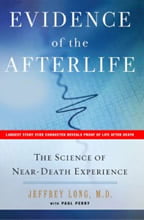
evidenceafterlife2Science has studied the near-death experience for more than 20 years. Most research has concluded NDEs are real and unexplainable, but scientists have been slow to accept consciousness beyond death. A new scientific study by Jeffrey Long, M. D. may change that. The research compiled in  his new book, Evidence of the Afterlife, represents the largest, most comprehensive study of near-death experience and according to the study’s author is, “a real game-changer”.

Dr. Long explains, “we looked at nine lines of evidence that indicate the reality of near-death experiences and their consistent message of an afterlife. With each of these lines of evidence we carefully reviewed all prior scholarly research on the subject and made our contributions with our original research… from my point of view, the scientific term is compelling, but you can put it another way — the nine lines of evidence that I present is proof of the reality of near-death experiences.”

The conclusions of Dr. Long’s research are paradigm smashing for near-death experience skeptics who’ve argued that limited brain functioning may explain NDEs. “What near-death experiencers see correlates to their time of cardiac arrest and it is almost uniformly accurate in every detail. That pretty much refutes the possibility that these could be illusionary fragments, or unreal memories associated with hypoxia, chemicals, REM intrusion, anything that could cause brain dysfunction”, Dr. Long stated.
“I looked at over 280 near-death experiences that had out-of-body observations of Earthly ongoing events… If near-death experiences were just fragments of memory, unrealistic remembrances of a time approaching unconsciousness or returning from unconsciousness, there is no chance that the observations would have a high percent of completely accurate observations. They’d be dream-like or hallucinations. But 98% of them were entirely realistic… In fact, these observations of Earthly ongoing events often include observations of things that would be impossible for them to be aware of with any sensory function from their physical body. For example, they can see the tops of buildings. They can see far away. In my study over 60 of these near-death experiencers later went back and independently attempted to verify what they saw in the out-of-body state. Every single one of these over 60 near-death experiencers that reported checking or verifying their own observations found that they were absolutely correct in every detail.”, Dr. Long said.

While some near-death experience researchers have been reluctant to make the leap from NDEs to proof of the afterlife, Dr. Long is convinced by his research findings, “I’ve gone over every skeptic argument I can get my hands on. At the end of the day, I have no doubt in my mind near-death experience is for real. It’s a profound and reassuring message that we all have an afterlife. Every single one of us. And it’s wonderful. It is probably the greatest thrill of my life to be able to carry forward that important message to the world. I wouldn’t do it if I weren’t absolutely convinced that it’s correct.”

The conclusions of this research will be controversial, but Dr. Long stands ready to take on the critics, “I would be delighted to debate any near-death experience skeptic, any time, any place, on any media, as long as they’re scholarly, well informed, and as long as it can be a very high-level, intellectual debate.”

Jeffrey Long, M.D., is a physician practicing the specialty of radiation oncology (use of radiation to treat cancer) in Houma, Louisiana. Dr. Long has served on the Board of Directors of IANDS (International Association for Near-Death Studies), and is actively involved in NDE research. His book, Evidence of the Afterlife (HarperCollins), was published in 2010.

From Dr. Long’s website: Does Near-Death Experience (NDE) Evidence Prove an Afterlife?
Consider the Evidence, and Determine YOUR Answer!

Play it:

Audio clip: Adobe Flash Player (version 9 or above) is required to play this audio clip. Download the latest version here. You also need to have JavaScript enabled in your browser.

Download MP3 (39:09 min.)


Read it:

Alex Tsakiris: Welcome to Skeptiko, where we explore controversial science with leading researchers, thinkers, and their critics. I’m your host, Alex Tsakiris, and on today’s show I have an interview with Dr. Jeff Long, author of, Evidence of the Afterlife.  As you’ll hear, Dr. Long is probably one of the most qualified near-death experience researchers. He’s just compiled a huge body of that research into this book. This guy delivers the goods. I had a chance to interview him a few months ago for the documentary film that I’ve told some of you about that we’re putting together. He’s on top of his game. A medical doctor, well qualified in the field of medicine; also a very accomplished researcher.

I think you’ll really enjoy this. I think if you like the kind of hard-nosed debate that really gets down to the issues, really gets down to the research, then you’re really going to enjoy this dialogue. We talked directly about some of the points that were made by Dr. Kevin Nelson in the last episode of Skeptiko. I think you’ll be interested to hear what he has to say about that, but then there’s a whole new line of research and thought that he brings to this issue. So let’s hear from Dr. Jeffrey Long.

We’re joined today by Dr. Jeff Long, who is an internationally recognized expert on near-death experiences and the author of Evidence of the Afterlife. I was just chatting with Dr. Long here for a minute before we got on the phone, and he informed me that - correct me if I’m wrong - but this is now eight days after the release of the book, a New York Times Bestseller. Is that correct?

Dr. Jeffrey Long: That is correct.

Alex Tsakiris: Well, how exciting. Welcome to the show, Dr. Jeff Long.

Dr. Jeffrey Long: It’s good to be here. Thanks for the opportunity.

Alex Tsakiris: Dr. Long, fill people in real quickly, a quick sketch, of your bio, your background, both as a physician and as someone who’s become quite a well-known near-death experience researcher.

Dr. Jeffrey Long: Sure. I’m a physician practicing the medical specialty of radiation oncology, which is the use of radiation to treat cancer. I’m practicing at a premier cancer center in small town, Houma, Louisiana. I started my near-death experience research about ten years ago when I set up a Web site devoted to having people that have had these exceptional experiences fill out a questionnaire and then we would post their experience on the Web site, anonymously of course, with their advanced permission, and share it with the world.

For over a decade, this was a non-profit organization. It actually cost us quite a bit of time and money to run it. Just very recently we realized we had such an extraordinary message that we absolutely were compelled to share with the world, and hence several years ago I began work on Evidence of the Afterlife, the Science of Near-Death Experiences.

This is by far the largest scientific study of near-death experience ever published. It has over 1,300 near-death experiences and because we’re studying so many near-death experiences, we have the ability to come to some understandings about near-death experience that we just simply couldn’t come to before with less extreme data than we have now.  I might add, the near-death experiencers, not only are there so many of them, but the questionnaire they fill out, the current version, has 150 questions. It’s also a huge number of near-death experiencers studied and they’re also studied in enormous depth.

Alex Tsakiris: Great. I would just interject from a prior conversation we had that the methodology that you use in collecting these surveys and analyzing the data is really quite extensive and designed to eliminate all the possible problems that come up with survey work. Just so folks know, you are not only an accomplished physician, but you know how to do research. This is a well-done research project that is recognized in terms of the methods that are used.

Dr. Jeffrey Long: That is a good point. Actually, just my medical curriculum vitae is eight pages long, so I was very meticulous in making sure that the results of this survey and the conclusions we have would be scholarly and scientifically sound, you’re correct.

Alex Tsakiris: What I wanted to jump into, because the book, Evidence of the Afterlife, is a great read. A lot of people will find it very meaningful for them. But what we focused on in this show on Skeptiko is really providing a forum for controversial research — and near-death experience research is controversial for very many people — a forum for two sides to kind of square off on this.

As you know, I spoke recently to Dr. Kevin Nelson from the University of Kentucky, who is - I guess the only way to describe it - is a near-death experience skeptic, a neurologist who’s offered an alternative explanation for the near-death experience.

One of the ways I thought we could jump into this dialogue and better understand where you’re coming from on your near-death experience research is maybe compare and ask you to comment on some of Dr. Nelson’s ideas. Would that be okay?

Dr. Jeffrey Long: That would be great. I actually helped recruit near-death experiencers for Dr. Nelson’s research, so I’ve talked with him. I have a great deal of respect for Dr. Nelson and his scholarly approach and I encourage all scholarly study of near-death experiences. That’s very important for everybody to know. But I certainly strongly disagree with Dr. Nelson’s conclusions.

Just in a nutshell, and again this is not going to fully do justice to the very extensive article Dr. Nelson published in the very prestigious journal, Neurology, but briefly, Dr. Nelson believes that many, if not all of the elements of near-death experience can be explained by a phenomena called REM intrusion. REM is an abbreviation for rapid eye movement.

What Dr. Nelson is proposing is that when people face a life-threatening event they have that so-called fight-or-flight response and as a result of that, the nervous system creates some type of, if you will, dream-like, unrealistic images which at the time of a life-threatening event and with borderline marginal consciousness, may ultimately be considered to be the elements of a near-death experience.

Again, I would emphasize that’s a very complex, very large article he has, but that’s basically the gist of it. The gist of it is that Dr. Nelson believes that we’re observing near-death experiences, but people’s experience can lead, to a large degree, be based on this phenomenon of REM intrusion. I just noted my research that I’ve done, but I’m published in the book as well as other scholarly research that precedes it. It gives a completely different picture.

Alex Tsakiris: Why don’t you tell us real briefly the methodology that Dr. Nelson used to arrive at his conclusions, and how that compares to what you’ve found and the methodology used? I guess what I’m really driving at is Dr. Nelson ended up doing a survey in some respects similar to the survey work that you did, but he came at it with some different questions and obviously, came away with some different conclusions.

Dr. Jeffrey Long: Sure. Dr. Kevin Nelson, working with me, we were able to recruit I believe it was approximately 55 people that had a near-death experience. As a result of that, he then did a survey. He wanted to ask the near-death experiencers that he surveyed four questions that were focused on whether they had a prior life experience of REM intrusion.

He compared that to the responses to a comparison group of people that he recruited from his own medical department as well as from, as I understand, some other sources. When he compared the two groups he found that people that had had a near-death experience in, as I recall, several of the questions that he asked, had a statistically higher affirmative response to questions about a prior life history of REM intrusion. That is the study that underlies his conclusions.

Alex Tsakiris: Great. I don’t want to bore people too much with the details of criticisms that you have of that, which I think are spelled out really well in the article that you sent me, but maybe you could give just a thumbnail sketch of some of the problems you see in the way he went about that and the conclusions that he came to.

Dr. Jeffrey Long: Well, first of all, in his very own published study, 40 percent of those that had a near-death experience answered “no” to all the REM intrusion questions he asked them. That is a substantial minority. That alone brings into serious question whether you can say REM intrusion underlies all near-death experiences. I think that almost single-handedly refutes that.

Secondly, when the questions that he asked talked about visual and auditory experiences that weren’t necessarily caused by REM intrusion. So the problem is near-death experiencers that have had a very unusual, remarkable experience are certainly more attuned to the possibility of encountering REM intrusions whereas other people dismiss it.  For example, I personally was waking up one morning and I heard my cell phone go off. I heard it loud and clear. It rang twice in the other room. I was a little miffed that someone would call so early, so I said, “Well, I’d better get up. Maybe it’s important.” Got up, and the phone had not rung. I was able to check to see if anybody had actually called. Indeed, no one had.

That was an episode of REM intrusion. It was an auditory hallucination occurring at the time of awakening. Now because I have an interest in this and I’m fascinated with the phenomena, of course I’m going to remember that the rest of my life. But you, other people that aren’t interested in this kind of a topic, you’ll forget about that. You won’t even remember that happened a week later. So again, I think that’s one of the real biases here.

In the absence of a prospective study of near-death experiencers versus non-near-death experiencers, it’s really hard to argue just from differences in surveys that that’s really a true difference in their prior life experience with REM intrusion. Near-death experiencers may simply be remembering it more than non-near-death experiencers. That would be entirely plausible, especially if you’ve had a dramatic, unearthly experience like a near-death experience.

One of the interesting concerns I had about Dr. Nelson’s study is that the questions they asked just simply asked, “Have you ever had a prior life experience of REM intrusion?” Well, the problem is even for the near-death experiencers that said that they had, you don’t know whether that so-called REM intrusion occurred prior to their near-death experience or whether it was actually an after effect precipitated by the near-death experience.

So that doesn’t necessarily mean that they’re more predisposed to have REM intrusion before their NDE than anybody else. That study really isn’t designed to do that. I think that’s a very, very important point, especially with near-death experiencers being much more interested in non-normal phenomena in their life after an experience like that. I think that’s another major concern that I have with the Dr. Nelson study.

Alex Tsakiris: Let me just back up and get back into the bigger picture because what I’m hearing you say, and you did a very good job of laying out the particulars, is that there’s some reason to maybe look twice at Dr. Nelson’s conclusions and you’ve laid out some of the reasons for that.

But if we take a big step back, what really struck me in my conversation with Dr. Nelson is - I just have to say - not that here was a colleague, a fellow near-death experience researcher who was coming to the table and saying, “Gee, let me put my shoulder behind the wheel and find out what’s really going on.” I mean, what he led with is this burden of proof thing. “I think the burden of proof is on the individuals who are making these extraordinary claims and the idea that consciousness is independent of the brain is a matter of faith, not of science.”

He came out with some very, very strong-minded language from this kind of skeptical position that we hear so many times from neurology types and folks who are very materialistic in their view of the world and say, “This cannot happen under any circumstances.” Let’s deal with the burden of proof. These individuals are making extraordinary claims and the burden of proof is on them. This is a matter of faith, not of science.

Dr. Jeffrey Long:   Oh, I’d be glad to address that. I think the concept that consciousness can exist apart from the body, the concept that near-death experiences are real, is absolutely relative to the perspective of the scientific community and an absolutely exceptional, remarkable claim. I personally have no problem facing the scientific community and saying, “I couldn’t agree more.”

This is an exceptional claim that near-death experiences are real and therefore, I willingly accept the burden of proof to prove that near-death experiences are real. Here’s the good news: prior scholarly research has pretty much nailed down the reality of near-death experiences, and my most recent book took all the scholarly evidence that we have available to us. We did a lot of original research and really greatly extended the information we have that indicates that near-death experiences are absolutely real.

Alex Tsakiris: So you that that burden of proof issue, even if you take that on in its fullest, is addressed in Evidence of the Afterlife?

Dr. Jeffrey Long: Absolutely. No question about that. In fact, in Evidence of the Afterlife, we have nine lines of evidence that indicate the reality of near-death experiences and their consistent message of an afterlife. What each of these nine lines of evidence do is carefully review all prior scholarly research on the subject and we make our contributions with our original research from the work that I’ve done on the subject. Then we have written it up and put it in the book. From my point of view, the scientific term is compelling, but you can put it another way.

The nine lines of evidence that I presented and an awful lot of other people believe who have read the book, consider this to be proof of the reality of near-death experiences and proof at the level of “need exceptional evidence. Dr. Long proved that.” We’re there. This book is a real game-changer, to be frank about it. I think this really changes the field.

I would also say that of course Dr. Nelson could not have been aware of the content of this book. It was only released January 19th, but the content of the book and some of the original research that I’ve done and present is really some of the strongest evidence that we have available that near-death experiences are real.

Alex Tsakiris: Let’s explore several of those lines of evidence because one of them will be directly relevant to addressing Dr. Nelson’s next point. That’s how do we know that the near-death experience is really happening - in any particular case - when there is a flat EEG?

Dr. Jeffrey Long: Well, let’s talk about some of the best evidence the way I see it that indicates that near-death experiences are not REM intrusion. REM intrusion is rapid eye movement and that involves having visual stimuli. I think the class of near-death experiences that single-handedly refutes REM intrusion as being the cause of all near-death experiences are those that occur in the blind, including the blind from birth. There have been case reports of these near-death experiences, not a lot of them, but they certainly are there. These people that are blind, totally blind from birth, have absolutely typical near-death experiences with very complete detailed visual observations.

Alex Tsakiris: They never saw anything during their life, don’t have any sense of color, their sense of color is based on either a sense of smell or feeling or they use their other senses. Now they have a near-death experience and they report seeing things. Is that correct?

Dr. Jeffrey Long: Absolutely. You cannot explain vision to somebody totally blind from birth in terms of their remaining four senses. It’s absolutely impossible. So for them to have vision for the first time in their life, during a near-death experience, is incredible. The people that are blind, blind from birth, do not have REM intrusion. They can’t. It’s physiologically impossible. So the fact that they have typical near-death experiences, if you will, single-handedly refutes REM intrusion underlying all near-death experiences. At an absolute minimum, clearly there’s something else going on other than REM intrusion in some near-death experiences, just based on this. REM intrusion absolutely cannot explain that.

Alex Tsakiris: Let me jump to another point. This has come up not only with Dr. Nelson but with other neurologist types, and that’s this idea of a flat EEG. You get to the point where you say, “Okay, we have medical evidence that people were being monitored when they had cardiac arrest and they had an EEG monitoring. They had a flat EEG. They still reported a near-death experience. Do we have any evidence at all that would suggest that in any instance, ever, that their near-death experience occurred while they had a flat EEG?

Dr. Jeffrey Long: The best evidence that the near-death experience is occurring during the time of their cardiac arrest comes from the out-of-body experiences that about 45 percent of the near-death experiencers report.

Let me back up a minute. When you have a cardiac arrest, which means your heart stops, immediately blood stops flowing to the brain. Unconsciousness occurs within seconds and within about 10 to 20 seconds of people that have a cardiac arrest, the EEG electroencephalogram or measurement of brain electrical activity, goes absolutely flat. During that period in time, it is impossible to have an organized, conscious experience.

However, that’s the time when near-death experiencers have it. How do I know that? Well, that’s easy. I and prior researchers have considered how realistic these out-of-body experience observations are. There’s no question when people have a near-death experience. What they’re reporting is occurring at the time when there are frantic resuscitations ongoing; it’s very typical that they return to their body after they’ve been defibrillated or the paddles have been placed and shocked, if you will in the vernacular. Certainly they’re actually observing Earthly ongoing events, again about 45 percent of near-death experiencers at this time.

What I did is I looked at over 280 near-death experiences that had out-of-body observations of Earthly ongoing events. I looked for any hint that any detail of what they were reporting was unrealistic. In other words, if near-death experiences were just fragments of memory, unrealistic remembrances of a time approaching unconsciousness or returning from unconsciousness, there is no chance that the observations would have a high percent of completely accurate observations. They’d be dream-like or hallucinations.

The hallmark of what they observed in the out-of-body experience would be unreal. Is that what we observed? The answer is absolutely not. In my review of these over 280 near-death experiences, 98 percent of them were entirely realistic by my assessment of these out-of-body observations, as well as the near-death experiencer who shared it also believing that there was no error in what they saw whatsoever.  At least they did not report that they had any reservations whatsoever about the accuracy of what they saw. We’re talking about an overwhelmingly high percentage of people with entirely realistic observations in every detail.

In fact, these observations of Earthly ongoing events often include observations of things that would be impossible for them to be aware of with any sensory function from their physical body. Very commonly, consciousness rises above their body. They can see the tops of buildings. They can see far away. They can see outside walls. Just about every single time a near-death experiencer reports that, their observations are absolutely correct.

In fact, of my study series of these out-of-body observations during near-death experiences, over 60 of these near-death experiencers later went back and independently attempted to verify or refute what they saw in the out-of-body state. Every single one of these over 60 near-death experiencers that reported checking or verifying their own observations found that they were absolutely correct in every detail. There’s no question about that.

If there was any cause of brain dysfunction, hypoxia chemicals, REM intrusion, anything that could possibly cause brain dysfunction and create hallucinatory, illusionary experiences, none of that is happening.

I might add that there’s been a prior scholarly study of over 90 near-death experiencers where they found 92 percent of the observations of these NDEs and the OBE state were accurate in every single detail. So no question about that.

What near-death experiencers see correlates to their time of cardiac arrest and it is almost uniformly accurate in every detail. That pretty much refutes the possibility that these could be illusionary fragments or unreal memories associated with REM intrusion or anything else.

Alex Tsakiris: Great. You couldn’t have addressed that more directly, but I’m going to go back and hit it one more time with the exact language that Dr. Nelson used. What he said is that this is a common misconception and that cardiac arrest doesn’t mean that there’s no blood flow to the brain. They could be going in and out of a conscious experience.

Now, also by implication, he’s suggesting that everyone who has a near-death experience is going through that state of having some blood flow and going in and out of consciousness. That would have to be part of his assumption, because obviously in this case, if there’s any one particular case where there’s zero blood flow, where there’s a complete flat EEG, no gag reflex, none of that. One case kind of opens the whole door here. Let’s just nail that completely.

Dr. Jeffrey Long: Let’s start with nailing that down first. I’ve got a lot to say to that. In addition to my study and another retrospective study that I addressed about how realistic out-of-body observations were, there have been two separate prospective studies that have been done of people that have had cardiac arrest. Then these researchers studied the entire group. Some had near-death experiences and some don’t.

Both groups were asked to describe their resuscitation efforts. Those that had near-death experiences and those that observed their own resuscitation efforts were incredibly accurate, typically down to even very, very fine, minute details. If they had a near-death experience and saw their own resuscitation. On the other hand, the control group, that being those that had a cardiac arrest and did not have a near-death experience, their recount of their out-of-body observations were generally highly inaccurate.

So we actually have two separate studies, both of which pointing to the fact that it is the near-death experience. It is that experience that allows accurate out-of-body observations. That pretty much excludes the possibility that it’s this drifting in and out of consciousness or anything else. No doubt about it. What people see during a near-death experience, both by large retrospective studies and prospective studies are verified as accurate.

Alex Tsakiris: I think anyone who bothers to really dig into your book, Evidence of the Afterlife, is going to get a really good sense of that. Let me back up then for a minute and hit another point that you touch on in the article that you wrote for the Journal of Near-Death Experience, addressing Dr. Nelson’s points. And that’s this: why do you think the scientific community is so welcoming of these alternative explanations for the near-death experience, even when we analyze them carefully, they’re on some pretty shaky ground relative to the larger body of near-death experience scholarly work that we have, including yours and other near-death experience researchers?

Dr. Jeffrey Long: That’s a good question. First of all, as an overview, there’s certainly a lot of other explanations for near-death experiences other than REM intrusion. In fact, skeptics of the near-death experience have proposed over 20 - that’s right, over 20 - different alternative explanations for near-death experience that span the spectrum of physiologic so-called causes, psychological, sociological, culturally-determined causes.

The reason that there’s so many of these alternative “explanations” out there is that these skeptical explanations of near-death experience, no one or several of them make sense even to the skeptics. I think that’s an important point. I mean, certainly the skeptics can’t really point to any one or several explanations and say, “Aha! This must be it because the evidence is so solid.” Even the skeptics themselves realize that there’s a huge number of different explanations because they can’t agree on what really makes sense. That’s a really important point if you look at skeptical arguments. There’s a lot of them.

So the question is - and an important question you raise - why isn’t there more scientific acceptance of these hundreds of scholarly articles that have been written about near-death experience? I might add these are in some of the world’s most prestigious medical journals. That’s absolutely a fact.

I think that one of the biggest issues is that the concept that consciousness can exist apart from the body is radically different from any other concept that the conventional scientific community has. As we’ve said before, especially to the scientific community, these types of exceptional claims, that being the reality of near-death experience, really does require some exceptional evidence.

I think the concept that near-death experiences are real and consciousness can exist apart from the body is such a radical concept for scientists that it’s very, very hard for them to accept that. In fact, I think it’s such a shift from the way they’ve been taught and the research that they do, that in general it’s hard for them to even get interested in studying in-depth the scholarly literature that underlies the concept that near-death experiences are real.

Alex Tsakiris: I think they’re afraid how far down the bunny hole they’re going to fall and what it’s going to do to the mountains and mountains of work they’ve accumulated in their career. I mean, folks say that directly. What would that do to my career?

Dr. Jeffrey Long: That would a real issue. I think probably more commonly the issue is that they just simply can’t believe it. I mean, if it’s so outside of their life experience and if it’s something that is not a part of their prior belief system, in general people on just about anything will seize on any kind of evidence or line of thinking to negate or not be interested in anything that challenges their belief system. I think that’s just a naturally human response and scientists are no different.

Of course, the people who have had a near-death experience, essentially 100 percent of them come back being very convinced of its reality. The interesting thing is that includes near-death experiencers that were scientists and physicians themselves. If they ever doubted near-death experience before, once they have one they come back, grow to understand it, they accept the reality of near-death experience. Again, there’s no substitute for personal experience and if you haven’t had a personal experience with an NDE, then it’s just very, very difficult to accept that such a remarkable experience is real.

Alex Tsakiris: Absolutely. Dr. Long, I think you wanted to mention one other line of evidence that you think really comes into play prominently.

Dr. Jeffrey Long: I have nine lines of evidence. I think any one or several are certainly very convincing to a lot of people. I think another line of evidence that really refutes the possibility that REM intrusion or any functioning of the physical brain whatsoever has anything to do with near-death experiences are those near-death experiences that occur while the person is under general anesthesia.

The only explanation for a conscious experience while under general anesthesia is that you’re not under general anesthesia; that you have partial awakening. That’s very, very rare. No more than two or three in 1,000 anesthesias have any of that. I don’t want to frighten anybody about…

Alex Tsakiris: Hey, let me stop you there, Dr. Long, because the first time that we talked a few months ago, it really came as somewhat of a surprise to me - not for other folks - but for me, I didn’t really realize how deep anesthesia is. So for the common layperson like me, tell us a little bit about what being under anesthesia really means.

Dr. Jeffrey Long: For those that have had a personal experience with anesthesia, you know you go to sleep, you wake up, and your time under general anesthesia is a totally blank slate. I’ve given anesthesia, even when I was a medical student, and I’ve been there with lots of patients that had general anesthesia.

Usually when you’re under general anesthesia you’re under so deep that there’s absolutely no possibility of a conscious experience. Once again, electroencephalogram measurements - a measurement of brain electrical activity - under general anesthesia show complete disorganization. Once again, proof that there’s no possibility of a conscious experience under adequate general anesthesia. In fact, very often people are so deep asleep that they have to be artificially ventilated, which means there’s machines that breathe for them because if you didn’t, they’re so deep under general anesthesia they’d die due to lack of breathing. That’s how profoundly unconscious people are while under general anesthesia.

Yet this is the time that people have near-death experiences. In my research, we had a population of 23 near-death experiences that to me were quite convincing that occurred under general anesthesia. I compared 33 near-death experience elements of these people under general anesthesia with all other near-death experiences occurring under all other circumstances. In comparing those 33 elements statistically between the two groups, for 32 of the 33 elements there was absolutely no statistical difference at all between the two groups.

In other words, these people are having essentially identical near-death experience content, whether they’re under general anesthesia or not. This has been observed by other researchers as well. There’s multiple, multiple other near-death experience reports that occur under general anesthesia. I would argue that if you had even a single established proven near-death experience under general surgery that that would prove it. But there’s actually dozens out there that have been reported, including in my own study. The fact that the content is absolutely the same as all other near-death experiences, once again almost single-handedly refutes that these experiences are due to any possible physical brain function.

Alex Tsakiris: Great. That is very convincing, very convincing evidence. So then, real quickly Dr. Long, what is coming up for you in the near future?

Dr. Jeffrey Long: Well, certainly we’re going to continue to spread the word about my book, Evidence of the Afterlife, now that it’s a New York Times Bestseller. I’m sure there’s going to be a lot of interest and certainly we’ll be involved in a number of media presentations.

Alex, I sure appreciate your interest. A lot of people have a lot of interest in this book so far, and that’s exciting to me since it’s my first book and I really worked very hard to make sure that it was scholarly and factual.

Alex Tsakiris: I’m sorry, but you’ve also hit some very big outlets. You were on the Today Show. What are some of the other…?

Dr. Jeffrey Long: Oh, yes, Coast to Coast AM.  I think we’ve got at least several more TV shows going up in the near future. Probably more and more media contacts and media involvement is probably going to happen within the next few weeks. I just found out I was a New York Times Bestseller yesterday afternoon, so that’s certainly going to open some doors in terms of some other media presentations.

I think in wrapping it up, I think I’d like to talk about the overall way in which we determine the reality of near-death experiences. There are certainly going to be the skeptics and there’s certainly going to be those that firmly believe that near-death experiences are real and evidence of the afterlife, such as myself.

When Kevin Nelson wrote his article, we wrote a very careful response to the evidence exactly as he presented it. In fact, we sent that article to Kevin Nelson prior to publishing it and made it very clear that if he had any response to that we would be very interested and I’m sure we would publish it. We heard no such response from Kevin Nelson. Now I have the book out, we have all the evidence for the reality of near-death experience.

I think if we’re going to as a society and scientific community, a variety of people with a lot of opinions on this both for and against; if we’re really going to nail down the reality of near-death experiences, both the skeptics and the proponents of the reality of near-death experience need to have the courtesy of responding to the evidence as presented on the other side. Not what we wish the evidence was, but we really need to have that scholarly in-depth understanding of what the other side is presenting.

We tried to do that with Kevin Nelson and unfortunately, we haven’t heard back a direct response from that article that we published in the Journal of Near-Death Studies. I would hope that Kevin Nelson or any other skeptic would do me the courtesy of carefully reviewing the evidence in my book, as well as the, if you will, the synopsis of all scholarly research, both pro and con, that I present in my book, along with my nine lines of evidence for the reality of near-death experience.

I would hope that we would have the courtesy and frankly, the integrity to respond directly to what the evidence of near-death experience is based on scholarly studies. If we simply hang to a belief system; if we’re not willing to address the evidence, whether for or against near-death experience, we’re really not doing anybody a favor. We’re really not advancing the scholarly understanding of near-death experience.

Alex Tsakiris: That’s very well said. You know, really pulling that apart, it’s basic science. I mean, that is the definition of science.

Dr. Jeffrey Long: Yes. I think true science involves addressing the evidence. In fact, a basic scientific principle is that which is real is consistently observed. I have over 1,300 near-death experiences in my research database. There’s no question that that is a consistent observation. You cannot use the term, “anecdote” when you talk about a research database that’s that great.

Moreover, basically all of my major points for evidence for the reality of near-death experience is very nicely corroborated by prior large scholarly study of near-death experience. Not only the depth of my own research, but the consistent observation of other researchers with different study groups finding the exact same thing, creates the body of evidence that I would hope that skeptics would have the courtesy, if not the integrity, to respond to directly instead of responding to something other than that real database, that real set of knowledge that we have about near-death experiences.

I think for the readers of my book, for the readers that really read in-depth both pro and con, the evidence for near-death experience, I think the light will come shining through for what the reality really is in all this, and that is without a shadow of a doubt, near-death experiences are real.

Alex Tsakiris: Dr. Long, best of luck with this important work.

Dr. Jeffrey Long: I sure appreciate that, Alex. This has been a real pleasure. Good luck. I sure appreciate your willingness to have a dialogue between proponents and skeptics of near-death experience. You’re doing a tremendous public service. The more people know about the argument both for and against, I think the better off we are.

Alex, one other thing I might leave you with. Certainly the arguments put for and against near-death experience can be somewhat complex and it’s hard for people to understand how powerful it is when you have multiple lines of evidence for the reality of NDE. One thing I’ve done to help people sort out how strongly they believe in the reality of NDE is actually on my Web site. If you go to www.nderf.org/afterlife, you can see the nine lines of evidence briefly summarized in my book. People can decide for themselves how convincing each line of evidence is for the reality of near-death experience and its consistent message of an afterlife. Then when you hit the calculate button at the bottom, you can see what that combination of evidence and exactly how strongly each individual believes how strong that evidence is. Each person can calculate for themselves how strongly they believe in the reality of near-death experience from that calculation engine.

Alex Tsakiris: That sounds fascinating. I haven’t seen that myself, so I’m going to go there and we’ll definitely point all our listeners there with a link in the show notes. Thanks again so much for joining us.

Dr. Jeffrey Long: It’s been a pleasure, Alex. Have a great day, and thank you all listeners.

Alex Tsakiris: Thanks again to Dr. Long for joining me today on Skeptiko. If you’d like more information on Dr. Long’s book, a link to the assessment that he talked about, please visit the Skeptiko Web site. It’s at www.skeptiko.com. There you’ll also find links to all our previous shows, a bunch of links where you can connect with me. I really enjoy hearing from you on Facebook, on Twitter, or dropping me an e-mail. You’ll also find a link to our forum where you can engage in more of a lengthy discussion on these topics.

So that’ll do it for today. I have several other interesting projects that I need to update you on and interviews that are in the can just waiting to get out there. So as fast as I can, I’ll get them out to you Skeptiko listeners. Take care and bye for now.

 
icon for podpress  Standard Podcast [39:09m]: Play Now | Play in Popup | Download
  • Share/Bookmark

posted in Skeptiko, Uncategorized, near-death experience, skeptic v. believer | forum discussion | Email Me


« 93. University of Kentucky Researcher, Dr. Kevin Nelson Skeptical of Near-Death Experience Accounts
95. JREF Million Dollar Challenge D. J. Grothe »
  • James
    Why can't people just accept that death is the end of it?
  • Jerry DeCaire
    How would you know?
  • Alex Tsakiris
    Posted by Steve:
    "30% blood flow(max) during cardiac massage is not sufficient to produce normal consciousness(let alone the vastly expanded consciousness experienced during NDE) under any circumstances. Otherwise, the common occurence of fainting (caused by slightly reduced blood pressure) would not ever occur. Even if 30% flow was enough to maintain consciouness, you are then stating that the NDE is 'a product of normal consciouness' when it clearly is not, otherwise everbody would be experiencing NDE's, willy nilly, all day long. In my fifty years as a conscious human being, I have never found myself observing my own physical body from a vantage point high up in the corner of any room, nor have I ever come face to face with deceased relatives in a brilliant unearthly light who provided me with information that my normal senses did not have access to."

    Great point! If very low blood flow to the brain (e.g. 15-30%) was the primary factor in brining on a NDE we would expect to see a correlation between this level of blood flow and NDEs... both during cardiac arrest and other times.
  • Steve
    It's bad minded rubbish, Alex. And I believe that Gerry Woerlee knows very well that it is. I'm disappointed in him because he is an intelligent, likeable guy.
  • Gerald Woerlee
    Sorry about the lack of clarity in the paragraph below, but I hammered it out at 5AM after an emergency operation.

    "Cardiac massage as applied to people with cardiac arrest generates such a flow of blood around the body in more than 20% of people with cardiac arrest, as well as sufficient blood pressure to sustain consciousness in 20% of people. See the graphs of studies demonstrating this at:

    http://unholylegacy.woerlee.org/lommel.php "

    This paragraph should read:

    "Cardiac massage as applied to people with cardiac arrest generates a flow of blood around the body of more than 2 liters per minute in more than 20% of people, as well as sufficient blood pressure to sustain consciousness in 20% of people. See the graphs of studies demonstrating this at:

    http://unholylegacy.woerlee.org/lommel.php "

    I hope that clarifies this paragraph ...

    Gerald Woerlee
  • Gerald Woerlee
    Oh dear Steve, it seems we’re talking in circles again. I haven’t been able to do much on the internet due to work pressure. However let’s look at some of the interesting points you implicitly raised.

    I’ll start again with a description of the heart. The heart is no more than a pump which pumps blood around the body - only it’s made of meat instead of metal. Proof of this is provided by heart transplant patients awaiting a donor heart. The hearts of some of these people are so diseased, that they will certainly die before a donor heart becomes available. So what do physicians in the “good old USA” do? They remove the heart and replace it with a pneumatically driven artificial heart which does just one thing – pump blood around the body. These patients are discharged home, carrying a battery powered pneumatic pump connected to tubing going into their chests which drives their new artificial heart. They can live and work this way for several months until a donor heart becomes available. This clearly demonstrates that the heart has no magical function, except to pump blood around the body. See excellent review of experience with such artificial hearts at:

    Original article at: http://content.nejm.org/cgi/reprint/351/9/859.pdf

    This brings us to the point of how low a flow of blood pumped by the heart is needed to sustain consciousness. Patients with severely failing hearts are a wonderful source of information about this. Heart failure means that the pump function of the hearts of these people is failing, and is reduced below normal. Measurements of the flow of blood pumped by the hearts of people with heart failure have been extensively studied and measured. These studies show that consciousness is present even when the heart pumps volumes as little as 1.5 litres per minute = 25% of what is normal. You can read the original research in (Chronic Heart Failure, 2004;10(2 suppl 2):7–10) and:

    http://www.clinsci.org/cs/102/0247/1020247.pdf

    Cardiac massage as applied to people with cardiac arrest generates such a flow of blood around the body in more than 20% of people with cardiac arrest, as well as sufficient blood pressure to sustain consciousness in 20% of people. See the graphs of studies demonstrating this at:

    http://unholylegacy.woerlee.org/lommel.php

    And indeed some people are very evidently conscious during cardiac massage applied for cardiac arrest. I have discussed this extensively with references to medical journals the above web address. However most remain unmoving and unconscious during cardiac massage for cardiac arrest. However this does not mean they are unconscious. Oxygen starvation as occurs during cardiac arrest and resuscitation, as well as many other conditions cause paralysis of the body, even though the person concerned may be fully conscious. I have discussed this phenomenon extensively with references to medical journal on pages 130-137 of the book “The Unholy Legacy of Abraham” which you can download and read at:

    http://unholylegacy.woerlee.org/index.php

    In other words consciousness is possible, even though people are paralyzed and unable to manifest this consciousness with speech or movement. This is why I can confidently predict that up to 20% of people undergoing cardiac massage for cardiac arrest are potentially conscious. And indeed, the study of Pim van Lommel in the lancet bears out this prediction quite well. I expect the AWARE study will demonstrate the same. See original Lancet article at:

    http://www.pimvanlommel.nl/files/publicaties/Lancet%20artikel%20Pim%20van%20Lommel.pdf

    This brings us to the matter of the clear and transcendental consciousness of people during NDEs. When looking at this matter you have the difference between observer and experience. An observer sees someone whose body is clearly malfunctioning, yet the person concerned feels wonderful and has transcendent experiences. All researchers and anesthesiologists using anesthetic drugs know that most people feel wonderful during oxygen starvation, even though they look like hell, and many people feel wonderful as a result of anesthetic drugs, even though they are incoherent and try not to breathe. The situation is similar to looking at a heroin user – the observer sees someone who in incoherent and looks like death warmed up, but the user feels wonderful, with transcendental consciousness etc. The same is true of NDEs. Make a careful distinction between the mechanism producing the experience, and the experience itself.

    NDEs are wondrous and profound experiences, but that does not absolve us from the necessity to look at the mechanisms producing these experiences.

    This is how I view NDEs. However, I have a very open mind. If any readers can provide concrete evidence of a scientifically PROVABLE, and repeatable PROVABLE mechanism, by which these experiences occur, other than the experiences themselves, I would be very interested. But please spare me Oprah Winfrey, Pam Reynolds, and the experiences themselves. These are not proof of the immaterial.

    Gerald Woerlee
  • steve
    Thanks for the reply, Gerald. You make cardiac arrest sound quite mild but as you well know, only between 1-15% of patients admitted into hospital survive and 25% of patients already in. Reperfusion also causes a lot of injury to the brain(massive cell damage) so even if cardiac massage is vigourous the brain is still inundated with oxygen free radicals and if no cardiac massage is given, within two minutes the energy stores are emptied. So either way we have severely compromised brains and therefore no viable consciousness. Now you(Gerald) say..AH, but patients have these complex experiences so there MUST be normal/abnormal consciousness present. But what you are doing here is attributing the brain(the television set) the same properties as the signal(separate mind)

    The man found in the meadow(Dentures)(Van Lommel et al) was comatose when brought in and remained comatose for around a week. He did not wake up under the thumper and see(with his physical eyes) his dentures being placed on the wooden shelf. (I have checked this out with Dr Van Lommel) Yet he knew where they were.
    You say spare me the Pam Reynolds case, but you would say that wouldn't you. The amount of barbiturates that she was given, shut her brain right down as monitered by the evoked potentials but apparently her remarkable ability to describe the setting and implements used( why should she conjure up a bone saw that looked like an electric toothbrush) is nothing special.
    Well, Gerald, you can keep saying there's no evidence, nothing there etc until you 'pop your clogs' as I expect you will, but there is a new generation of physicians coming through who are more open minded. That said, I don't dislike you and wish you well.
    Steve.
  • Gerald Woerlee
    Thank you Steve for your thoughtful reply. However, I am a stickler for accuracy. There are some things you imply and say which do need correction, because if uncorrected they will tend to lead their own life.

    I will begin with the new generation of physicians. I am not only a hardnosed anesthesiologist with an extensive generals practice, but am also an associate professor at the Leiden University Medical Centre. I train part of the new generation of anesthesiologists, and for my sins have even written three textbooks, of which two are devoted to the mathematical study of drug actions during anesthesia. Patient’s lives depend upon my residents accurate and logical thinking of physiological and disease processes. Only God will help their patients if they think in any other way. This is the new generation of specialists in Holland.

    This brings us to the next matter – cardiac arrest patients and NDEs. To begin with, I fully appreciate the high mortality of cardiac arrest. What we are speaking about here are the survivors, because dead people tell no one about their NDEs. And about 18% of survivors report undergoing an NDE. I notice you no longer dispute the levels of cardiac output necessary to sustain consciousness, or that such levels can be achieved during cardiac massage. It is good that you mention the problems of reperfusion injury and the free-radical flood. Absolutely true. These all result in people developing brain damage, or loss of memory of what happens to them during cardiac arrest and resuscitation. However, those who are able to clearly recount their stories and their NDEs are people who have minimal or no reperfusion injuries, or free-radical damage, because they survived intact without any neurological damage and could tell a coherent story. These are people who are not compromised, and in whom the oxygen supply to the brain was quickly restored. Note that the brain has no oxygen store except what is present in the blood flowing through the brain. This was discussed by Rossen & Kabat in 1943 (see: Archives of Neurology and Psychiatry (1943) 50 : 510-528). (N.B. Presumably this article is too recent to be mentioned in textbooks as yet).

    Then you mention the television set model of the brain. This is a paradigm I have already extensively discussed in my book “Mortal Minds”. This is unprovable, whereas brain function is provable. Briefly, that is the difference between the two models.

    The we come to the matter of the man with the dentures. I am pleased you spoke with Pim van Lommel about this. Pim van Lommel (PvL) is a retired cardiologist who worked in the Rijnstate Hospital in Arnhem from 1977-2001. Arnhem is separated by 20 km from the city of Nijmegen in the Canisius Hospital where this man was resuscitated. During 1979, PvL was simply a member of the cardiological staff of the Rijnstate, and would not have heard of the story at the time, even though interested in NDEs. His knowledge of the story as published in the Lancet during 2001 was second, and even third-hand (see the Dutch IANDS publication “Terugkeer” (2008) 19(3): 10-11). His detailed knowledge of the events comes from an interview of the coronary care nurse “TG” that took place in 2008, a whole 19 years after the events that occurred in 1979 (see “Terugkeer” (2008) 19(3): 12-20). (note that the person who reported the NDE died not too long after 1979).

    This brings us to the matter of the one week intensive care admission. The transcript of the interview with TG does not cover this intensive care unit period, because TG was simply a nurse at the coronary care unit, and knew nothing of what happened to the patient there. We also do not know if he was conscious or not during his stay there. A one week stay in an intensive care after a cardiac arrest can mean a number of things: excessive sedation, heart failure, neurological damage. We simply do not know. What we do know is that neurological damage is unlikely, because this man was discharged in good health. Moreover we also know that many people have only fragmentary memories or no memories at all of their stay on an intensive care unit, see:

    http://www.springerlink.com/content/cfpvgw4gvbnx35j7/fulltext.pdf?page=1
    http://www.jccjournal.org/article/S0883-9441(01)70001-9/abstract

    So a one week stay on an intensive care unit. Who know why? It was certainly not due to neurological damage.

    The we come to Pam Reynolds. I have extensively discussed this case in great detail Chapter 11 of my book “The Unholy Legacy of Abraham”. It keeps returning. Pam Reynolds would have received a standard dose of thiopental or etomidate to induce anesthesia. The effects of such a dose wear of within 10 minutes, which is why she would have been kept unconscious with Isoflurane with or without nitrous oxide. Setting up a patient for such an operation as she underwent would take somewhat more than an hour. (I have administered anesthesia for many hundreds of neurosurgical operations, and the setup as described by Sabom in “Light & Death” would have taken at least one hour after induction of anesthesia). People do sometimes regain consciousness during such anesthesia. I have occasionally had this occur, as have my colleagues. Moreover, Pam Reynolds story is one of awareness. It has all the typical earmarks. So the evoked response measurements mean absolutely nothing – she was awake. Even the American Society of Anesthesiology acknowledges that such monitoring is not absolutely trustworthy. You can read their practice advisory at this web address:

    http://www.asahq.org/publicationsAndServices/AwareAdvisoryFinalOct05.pdf

    Interesting stuff … As you see, when you fill out the details, the stories tend to become less magical. Have you other insights that may convince me?

    Regards,

    Gerald Woerlee
  • geraldwoerlee
    Hi Steve. As a stickler for accuracy, I was a bit hasty with my description of the origin of the man with the dentures story. As I said, I am pleased to hear you have spoken to Pim van Lommel about this story. Even so, there are some things worth knowing about this story. To begin with, the first part of any study is to get the timelines correct. This was my first task when studying this story for an article on this story which I have submitted to the JNDS.

    I will begin with the story of the “man with the dentures”. The events of this story took place in November 1979. The man was resuscitated in the Canisius Wilhelmina Hospital in the city of Nijmegen in the Netherlands. For the exact story I refer you to the 2008 JNDS article, or my website at www.unholylegacy.woerlee.org. According to the cardiology nurse who was at the resuscitation, the man who underwent this experience died not too long after discharge from hospital, which is why he is no longer available for interview. The first publication of this story was in 1991 in a Dutch magazine, using an account provided by another cardiology nurse who was not even present or involved with the treatment of this man. A second more detailed interview with the male nurse involved in the resuscitation was made during 1994. The most detailed interview with the male cardiology nurse involved in the resuscitation was not made until 2008, (which is 29 years after the event!). (This is all to be found in the 2008 autumn edition of the magazine of the Dutch IANDS associate “Merkawah”. If you want a copy I can send you a scan, but you will have to be able to read Dutch).

    Now we come to Pim van Lommel. He published an abbreviated version of this story in the 2001 article in the Lancet. In other words, he used the information from the abbreviated interview of 1994, or even worse the third hand version published in 1991.

    Now would Pim van Lommel have known of the events that took place in Nijmegen during 1979? We know from his own biography that he studied medicine in Utrecht (center of Holland), and finished his medical degree in 1971. It was during 1969, presumably during a clinical stage as a medical student on a cardiology unit that he first came into contact with an NDE from a patient who had survived a cardiac arrest. He specialized in cardiology in the prestigious Antonius Hospital in Nieuwegein which is a city next to Utrecht, and finished his specialization in 1976. He was appointed a specialist cardiologist in the Rijnstate Hospital in Arnhem in 1977, where he worked from 1977 until 2003. Nijmegen is 20 km from Arnhem, and the Rijnstate en Canisius hospitals functioned quite independently of each other in 1977 and 1979. Both are very reputable and large hospitals which still function quite independently of each other. So it is unlikely that he learned of this story in 1979. During 1979 he was a relatively new cardiologist with a busy cardiology practice in his own hospital. PvL actually told in an interview that he only renewed his interest in NDEs in 1986 after reading a book by George Ritchie, after which he started his research which ultimately lead to the well known article in the Lancet in 2001. So it is very disputable whether he knew of this story until after 1986 or 1991. But you can always ask him. (All this is a matter of public record and the content of an interview with him published on 9 February in the NRC Handelsblad newspaper. Again if you want, I can send a PDF, but it’s also in Dutch.)

    This is all fascinating background to the veridical OBE report of the “man with the dentures”.

    The male nurse “TG” who was present at the resuscitation, was also the head nurse present at the resuscitation, and was also the male nurse recognized by this man one week later on the cardiology ward. The 2008 transcript of his interview is very carefully performed and detailed. I regard it as a very accurate account of what this man saw, perceived, and experienced 29 years earlier.

    Gerald Woerlee
  • steve
    Gerald, I hardly deserve to take up so much of your time, but thanks for the two posts which are very interesting and as usual very well put together. Your professional expertise is not doubted, nor your knowledge of the workings of the human body and with these you have gone as far as any skeptic could do in explaining the near death experience in materialistic terms.
    However, I'm not persuaded that the man from the meadow woke up under the thumper and saw/heard with his physical eyes and ears, and then returned to coma. He himself said he saw it all from a vantage point away from his body and I believe him, because it would require that he was in a vantage point in order to get all the information and then have the CONVICTION that he was 'there.'
    Now of course, you may be right but you cannot exclude the possibilty that I am right, which brings me to my next point.
    Are you saying that it is impossible that human being's(or animals for that matter) have an immaterial soul ? If you are, that would be contrary to the scientific method so I will assume that you are not. So then, if you were not close-minded you would look at the 'pattern' that has been well indentified and then the various studies which I think point very strongly to there existing an immaterial soul... and weigh up the the evidence.
    I cannot accept that Pam Reynold's brain made a mnd model of a bone saw which just happened to look exactly like a midas rex bone saw and neither does Dr Spetzler or Karl Green(Spetzler merely says he has no explanation for it and karl Green says(as far as consciouness in the brain is concerned) all bets are off.
    I cannot accept that the nightwatchman(Sabom 78) was able to see all the grisly details of his own heart surgery. Nor the pilot who observed the fixed and moving needles on the crash cart. Nor the labourer who saw his family out in the waiting area...or the woman lying face downwards having an operation on her spine to remove a ruptured disc who saw it all while she floated around the room.
    I know you will probably remind me of some flaws in the methodology in Sabom's study but nevertheless, the six cases(leaving out fraud) are very impressive. There are hundreds of these cases and I can't accept that they don't mean anything.
    Regards, Steve
  • steve
    Regarding whether or not Reynolds aneasthesia failed , Spetzler has said that, "You might be able to make a case for that in the first few minutes... but not after !"
    The clicking nodules in her ears also emitted a very robust signal(many clicks a second) which would have prevented her from hearing Camilla Michaels say that 'the arteries are too small'
    Reynold's herself doesn't accept the reductionist explanations. Why doesn't she if it is the truth ? How does one obtain the unshakeable conviction for something that never happened ? Why don't any of the people undergoing these experiences accept your(and other skeptic's) explanations ? Why do you(and other skeptics) not accept their accounts of the immaterial human soul, performing exactly the way an immaterial human soul would do ? And if these are NOT pointers to an immaterial human soul, then what are the pointers ? And if you say, "Well, something more convincing than these unconvincing tales," then I would find such an opinion hard to accept from a person of your intellect.
    It is clear to me Gerald, that survival is anathema to you, for whatever reason. But, for the people concerned there is no doubt in their minds whatsoever. Would there be any doubt in yours if you had a NDE ?
    Regards, Steve
  • Gerald Woerlee
    Hi Steve,
    Thank you for a stimulating discussion.
    Once I thought that dualism in which you and 70% of Americans and people in the UK believe, could not be totally excluded. To begin with, the television analogy is rubbish. I use the better analogy of a driver in an automobile (see mortal Minds – Chapter 6 - “Control by the Soul”):

    The relationship of the soul to the body is similar to that of a driver and an automobile. The soul exerts control over the body through the mechanisms of the body, and the functioning of the mechanisms of the body express the control exerted by the soul. Accordingly, a study of how malfunction of the mechanisms of the body affect the control exerted over the body by the soul should reveal the location in the body where the soul exerts control over the body, as well as the existence of the controlling influence of the soul.
    Those who believe in the reality of an immaterial and immortal soul believe the soul controls all movements, all speech, all actions, and all deeds. Bodily movements, speech, actions, and deeds are visible, audible, detectable, and measurable. Accordingly, this belief means that movements, speech, actions, and deeds are the visible, audible, detectable, and measurable manifestations of the control exerted by the soul over the body. Muscles are the mechanisms of the body causing all body movements, because muscle movements produce all speech, muscle movements produce all actions, and muscle movements produce all deeds. So if the soul initiates and controls all conscious movements, speech, actions, and deeds, then the soul initiates, as well as controls the movements of muscles generating movements, speech, actions, and deeds. (Mortal Minds, pages 48-49)

    Chapters 4-14 in the book “Mortal Minds”, was devoted to a discussion of the properties of a possible immaterial controlling “something”, which for lack of a better term you could call a soul. I carefully looked and examined all evidence for the presence of a soul from the functioning of the body as revealed by disease and anesthesia. All the properties of the mind, free will, and consciousness can all be explained with the functioning of the human body. My conclusion was (page 56):

    These are a few examples of the effects that malfunction, damage, or destruction of different parts of the body have upon control exerted over the body by the mind as manifested by movements, speech, actions, and deeds. Everyday experience, everyday observation, and repeated experiment, prove these things again and again. These observations are facts. These observations all prove that if the mind is an aspect of the soul, then the soul only exerts control over the body through the mechanisms of the body, and that the functioning of the mechanisms of the body alters the bodily manifestations of the control exerted over the body by the soul. But this is quite different to what many people believe, and quite different to what is taught by most religions. After all, many people believe, and most religions teach, that the control exerted by the soul over the body is unaffected by the functioning of the mechanisms of the body.
    These two clear and undisputable facts about the control exerted over the body by the soul - any control exerted by the soul over the body is exerted through the mechanisms of the body, and any control exerted by the soul over the body is affected by the functioning of the mechanisms of the body - these two facts raise the question of whether the soul exerts any control over the body at all. After all, it is possible to explain all these observations of the effects of changes in body and brain function by saying that the mind is an expression of the functioning of the brain. This would mean that the soul is not the vehicle of the mind, but that the brain is the generator and the vehicle of the mind. Accordingly, if the mind is a product of the functioning of the brain, then changes in the functioning of the brain and the body will certainly alter the functioning of the mind, as well as all observable manifestations of the control exerted over the body by the mind, such as conscious movements, speech, actions, and deeds. Indeed, to explain mental activity as being a product of brain function, explains all observed facts with something provable, whereas to explain the expression of mental activity as being due to control exerted over the body by the soul through the mechanisms of the body, is to explain the expression of mental activity with something that is impossible to prove. So it is far more likely that the mind is a product of the functioning of the brain.

    So as you see, I left dualism in 2003 as an attempt at trying to prove the unprovable. Fortunately, I received an extensive transcript of the interview with the nurse “TG” present at the resuscitation of the man with the dentures. And he reported something really strange to the interviewer:

    Interviewer: Nee, oké. Beschrijft hij trouwens over die momenten dat hij pijn had ook nog dat tegelijkertijd nog wat kon zien. Was er een combinatie...?
    TG: Hij ziet zich onder dat apparaat, de hartmassagepomp liggen en dat doet verrekte veel pijn. En hij ziet mij ook tussendoor met hem bezig... (Terugkeer 2008, herfst, page 19)

    He reported feeling the pain from the cardiac massage at the same time as he was having an OBE and observing his body being resuscitated. This little detail was the final piece of the puzzle for me. It was proof that the OBE is a proprioceptive vision of the reality. This man’s consciousness was clearly in his body, otherwise he could not have heard the literal words spoken, and could not have felt the pain of the cardiac massage. So no, I consider the matter of dualism as a closed book. Dualism is no longer a second theoretically possible alternative to the idea that consciousness and mind are epiphenomena of brain function.
    All the other cases you mentioned are also explicable. However, this is not the forum for that, and each case also requires meticulous painstaking study. After all, as you see from the example above, clues to explanations often lie in the details.
    As to whether I would change my opinion after a personal NDE - I doubt it. I have been personally exposed to hallucinations aroused by body function, and have studied this subject too long to be anything else except rational. It would be interesting though.
    My opinions on survival after death have been more than eloquently expressed in the last chapters of my books. It is undesirable in the form most people imagine, and we have a form of immortality already (see last chapters of Mortal Minds, and The Unholy Legacy of Abraham):

    Each person is immortal, because of the fact of their existence, the effects of their existence, and the memories they leave behind them.

    Again, thank you for the interesting questions. Answering them in this type of forum was a good exercise in brevity. As I once wrote to another person, “We are all searching for truth of the reality, and it is only with reasoned discussion between opposites and likeminded people that we sometimes find the truth.”

    Gerald Woerlee
  • steve
    Just a point. You say that survival is 'undesireable in the form most people imagine'. Exactly...most people imagine centuries of poncing around on fluffy cumulous clouds playing the harp, bored to death trying to be holy and good(whatever good is).
    But if you study the NDE(not the evangelical ones) one can see that the experience is so ineffably wonderful, they cannot properly describe it. Why ? They should be able to describe the content of a 'mere anthropomorphic projection.' Have a look at old Evert Ter Beek on 'you tube' describing his nde, which occured notably on the fifth heart attack(is this why not everyone who has a heart attack has an NDE, but will eventually?) and you will see his longing to return to this place. I can't believe that he longs to merely return to an anomaly of the function of his own brain.
    Regards, Steve
  • Gerald Woerlee
    David Verbeek is certainly an interesting case. However, 30 minutes resuscitation is not unusual. Evidently the resuscitation did not start fast enough, or was not efficient enough to prevent global cerebral ischemia: blindness and paralysis. But there are some strange and inconsistent aspects to this story. To begin with, he forgot his past entirely. You say he forgot everything. Yet why did he not also forget how to speak? Why didn’t he also have any form of aphasia as a result of the global cerebral hypoxia? Global cerebral hypoxia would have also especially damaged his hippocampus, because the cells in the CA1 sector of the hippocampus are especially sensitive to oxygen starvation, and always occurs after such damage. And when the hippocampus is damaged, people cannot form long term memories such as that of his very vivid NDE and OBE. So there are several serious inconsistencies which Fenwick did not mention. So I ordered the book in which the case is described. Should be interesting.

    As for the matter of an ineffable afterlife as experienced by NDErs, I still think this is a explained by the differences between observers – and those experiencing NDEs. Even if such an ineffable afterlife exists, what is the purpose of eternal ineffability? Ineffability without purpose is as pointless as “poncing around” as you describe.

    I think we’ve gone as far as we can with this discussion at the moment, and wait for the ten Donald Ducks of the AWARE study. Our expectations are very different, but who knows?

    Thanks for the discussion,

    Gerald Woerlee
  • Steve
    Okay, Gerald, it's been good talking to you. I just want to add a few extra points to the debate, though.
    If 'Denture Man' had in fact woken up under the thumper and seen Ton Goossen(male nurse) with his physical eyes, I believe that 'Denture Man' would have reported it as follows.
    " I awoke in terrible pain with tunnel vision and saw 'you' (Ton) looking down into my eyes. I only saw part of your moustache but that was enough to remember you... and then a hand which I assumed to be yours, removed my teeth. The pain was terrible and I realised I was dying but I was so concerned with not losing my teeth that I did my very best to imagine all the places that you might put them. Therefore it is only a guess, based on the noise of a bottle I heard clank, but I believe you put my teeth in the drawer of a cart, even though I did not see a cart because I coudn't turn my head. I'm not even sure why I thought there was a cart, but if there was, it may have had bottles on it. Am I correct ?

    TG -"Yes, 'Denture Man,' you are indeed correct, that was an extremely good guess, what a coincidence, that it is where I put your teeth.

    The above scenario is what I believe would have unfolded if 'Denture Man' had been observing upwards from his physical position on the gurney. However , Denture Man didn't say that...he had the unshakeable conviction that he observed the scene from a position 'out and well away' from his body. So, I cannot see how he gets confused about his position in the room. He didn't need to make a mind model of himself observing the scene from a vantage point, because he had already decided where his dentures had been secreted.
    So, that is why I consider the undoubted craftsmanship of your explanations not convincing, Gerald, but you certainly do have a good bash at it.
    ---------------------------------------------------------------------
    David Verdegaal was so severely brain damaged that when the physiotherapist paid him his first visit and told Verdegaal to 'make a fist' with his hand, Verdegaal was completely unable to respond because he didn't know what a fist was, or a hand or a leg, nor what left or right meant. Yet he remembered his NDE !! Impressive, don't you think ?

    Don't close your book/mind, Gerald, you may be wrong.
    Best Regards, Steve
  • Gerald Woerlee
    As we are at the last points. Thank you for the name of the male nurse. So TG = Ton Goossen. As I said, the interview he had with Titus Rivas was actually a very good one. Your description of how his perception may have come to be is not at all so far from the way I see things. You only forgot the peripherally and centrally generated proprioceptive disturbances generating the OBE. As TG pointed out, he had seen at least one other patient wake up with pain during cardiac massage with the Thumper. The thumper from Michigan Instruments is a machine to provide cardiac massage during cardiac arrest, and is generally more efficiënt than cardiac massage by hand (see: http://www.michiganinstruments.com/ ).

    Curiously, most people tend to ignore two very important facts revealed by the interview with TG. The first point was (Terugkeer, 2008, herfst, page 19):

    Interviewer: Is het denkbaar dat die kunstmatige kleine circulatie, zoals je dat noemt, in principe voldoende zou zijn om gevoelens van pijn te veroorzaken?
    TG: Ja, dat kan. Ik heb zelf een geval meegemaakt van een andere patiënt die onder de hartmassagepomp lag die zelfs banger werd dan Beekhuizen. Hij werd zelfs wakker en we hebben de pomp snel uit moeten zetten, waarna hij overigens weer wegzakte. Dus hij had van zichzelf nog niet voldoende circulatie. Het kan dus voorkomen datje het reanimeren zo goed doet en zoveel zuurstof naar de hersenen transporteert dat dat blijkbaar voldoende is voor de patiënt om bij bewustzijn te kunnen komen.

    Translated:

    Interviewer: Is it conceivable that that “small artificial circulation” [flow of blood generated by heart massage], as you call it, in principle, would be sufficient to cause feelings of pain?
    TG: Yes you can. I have personally witnessed a case of another patient who was under the CPR pump that was even more afraid than Beekhuizen. He was awake, and we even have to turn off the pump quickly, after which he began sinking away. So he had insufficient circulation. It can occur that your resuscitation is so efficient that enough oxygen is transported to the brain to restore consciousness.


    In other words, consciousness during cardiac massage was possible in the efficient CPR setting of the Canisius Hospital during 1979. These machines are sometimes so efficient that some hospitals refuse to install these, and similar machines, because of the ethical problems associated with people who cannot survive on their own heartbeat after turning these machines off. The resuscitation committee in my hospital refused these machines two years ago for this reason too. The second important fact revealed in the interview with TG was:


    Interviewer: Een volgende vraag is dan of hij je misschien herkend kan hebben aan je stem. Je hebt tijdens die reanimatie dus gepraat en...
    TG: Dat zou kunnen en ja, mijn stem is, dat hoor ik van mensen wel vaker, als ik patiënten tegenkom die ik vroeger ook ontmoet heb, dat ze zeggen van "Hé, ik herken u aan uw stem. Hebt u niet ooit daar of daar gewerkt?" Dat klopt, dat mensen mij specifiek aan mijn stem kunnen herkennen. Dat zou in dit geval ook kunnen, dat hij me ook aan mijn stem heeft herkend.
    Interviewer; Maar alléén aan je stem?
    TG: Ja, dat weet ik niet, of hij me alleen aan mijn stem heeft herkend of de combinatie van stem en zien. Maar ik weet wel dat de mensen zeggen dat ik geen doorsnee stem heb. Ik heb een hese stem en mensen spreken me er wel eens op aan, ook niet-patiënten van "Ja, jouw stem herinner ik me wel". Ook van ex-collega's die je na tien jaar weer terugziet en die zeggen: "Hé, een bekende stem, die herken ik van vroeger." Ik heb wel eens gehoord: "Je hebt de stem van Chriet Titulaer".

    Translated:

    Interviewer: The next question is whether he might recognize your voice. You must have talked during the resuscitation and ...
    TG: That could be, yes, I often hear from other people, as well as when I encounter old patients, that they say, 'Hey, I recognize you from your voice. Did you ever work there or there?" That's right, people do recognize by my voice. That is also possible in this case, that he also recognized me by my voice.
    Interviewer: but only by your voice?
    TG: Yeah, I don’t know he recognized me by my voice or the combination of voice and sight. But I do know that people say I do not have an average voice. I have a husky voice and people comment upon it to me, also people who are not patients, “Yes, your voice I remember it". Also ex-colleagues I see after ten years back, they say: "Hey, a familiar voice that I recognize from the past." I've even heard: "You have the voice of Chriet Titulaer.” [ A old Dutch television personality with a husky voice]


    So TG had a unique sounding husky voice, which made him recognizable by his voice alone. These two facts, among several other reasons, are why I still consider the explanation of physical sensation the most likely explanation of this man with the dentures story.

    As regards matters we have not fully discussed yet - the jury is still out.

    However, I remain a materialist and humanist until more evidence. In the meantime I am also hard at work writing a new book on the ways anesthesia reveals the workings of consciousness and the possibility of a human soul. Should be finished within a few months.

    Best wishes,

    Gerry Woerlee
  • steve
    Gerald, yes I think I get the gist of your ideas which naturally are the accepted mainstream, which is a good thing, because we would not want the return of magic /witchdoctors etc conducting medical proceedures on patients, based on notions that the soul was able to overide the mechanics of the body(though it can and does sometimes, (I believe))
    I don't worry too much about anything below the kneck as having anything to do with whether or not the brain moves or operates it or the soul(mind), working through the brain being conversely unable to operate it, as quadraplegics are still conscious. What we need to look for to find evidence of duality is a good case were the brain was subjected to catastrophic oxygen deprivation(massive heart attack) which wiped out all previous memories but then made a collection of new memories that clearly coincided with the event and retained them when neuroscience says it is impossible to do so.
    David Verdagaal's brain(Fenwick and Fenwick) was so severely damaged(clinically dead for thirty minutes-Andreas Lotz) that he was considered by the doctors who attended to him to have no chance of survival. Nevertheless he did survive but woke up blind, paralysed and with no memories of the past, neither knowing who he was, his wife or friends were etc. You get the picture, Gerald. What he did remember, however, was his NDE which included a walk through a fantastically beautiful garden ( the like of which Verdegaal had never even imagined, let alone seen on earth) meeting God, and then returning, catching brief visionary snippets of seeing himself(from above) on a stretcher.
    So, WHERE were these memories formed ? If you say they were formed in his 'brain' ...why were they not lost with all his other memories ? Where did the memory of the fantastically beautiful garden come from ? He had no cognitive abilty to form such a bizarre memory and anyway even if he had, he shouldn't have been able to retain it. These things cannot be answered, Gerald, not by medical science because it doesn't make any sense. Fraud etc (not that you would think that of course, but others might) doesn't cover it.
    That is why(not just this case) I am not satisfied with the current paradigm.
    Regards, Steve
  • steve
    God knows why I've put a K in front of neck. Oh Kdear
  • Steve
    Wow, I'll need a bit of time to compose a reply to all that, Gerald, unfortunately I don't have it tonight. What I would say immediately is that the properties of this immaterial soul(which I believe in) are very capable of empathising with it's own physical body's predicament and pain if it wishes to. It's possible the 'denture man' (shall we call him) went in and out of his body but forgot he did it... but remembered the pain (as you do durig childbirth for instance)

    On the point of your decision to close the book on dualism, I think that is unscientific of you. After all, we are awaiting the results of the second(and very much bigger) multi-centre study in which I believe the controls are very good. Ten people seeing Donald Duck will be good enough for me, but I would say that, wouldn't I !
    Regards, Steve.
  • Grace
    I don't know if it's appropriate for your show, but I would be quite interested in hearing from someone who has had an NDE, about what happened to them and what their experience was like, and what their attitude towards it is. Does anyone know of anywhere there is an in-depth interview with an NDEr?
  • Max
    Grace,
    Check out coast to coast with Vicki Noratuk(now Blazon) blind from birth. You tube has a large selection of NDE's posted. IANDS website has some fascinating stuff, including a particularly interesting 'on point radio' interview with Sam Parnia. During the course of the programme, Jerry baldwin recounts his fascinating NDE which included a meeting with his grandfather who had died before Jerry was born.
  • jeffhall
    Alex:
    I'm a mathematician so I don't have a problem with the abstrations of M-Theory:) After Hagelin's model came another four 10D models all competing to be the unified field theory. It was the amazing Ed Witten who showed that these 5 models were all "shadows" of the same 11D model. Ed's result gave rise to M-Theory. 11 dimensions is enough to unify quamtum mechanics and general relativity.

    Gerry:
    Don't confuse the use of the word "conciousness" in this context with the vernacular expression which means "awareness". According to this new quantum theory of consciousness, even an atom posesses consciousness. Consciousness is a spectrum just like the electromagnetic spectrum (EMS) and in the same way that humans are only attuned to a narrow band of the EMS (light), our "awareness" is just a very narrow band of the spectrum of consciousness.

    In quantum mechanical terms, this new model of consciousness provides a source for "the observer" in the classical "double slit experiment" (search youtube if you want to know about that). It has been demonstrated to have a field effect - ie consciousness acts at a distance. It may actually BE the "Higgs field" that gives rise to mass.

    What I'm saying here is that there is now a sound scientific framework that provides the basis of an explanation for some "psi" phenomena like NDEs, telekinesis, telepathy etc. It's one thing to have hard data that proves the reality of NDEs but its quite another thing to explain that data rationally. Clearly we need a new scientific paradigm to explain these phenomena and M-Theory could be the direction in which those hidden mysteries of nature and science will be found. Only time will tell. It may be several generations before it is respectable for scientists to acknowkledge phenomena like NDEs as fact.
  • Gerry Woerlee
    Dear Jeff,

    I’m afraid I cannot match your knowledge of mathematics or quantum mechanics, but I do know about the double slit experiment and the effects of observation upon quantum mechanical processes. These are fascinating subjects I follow in the popular scientific press. However, the fact that observation exerts these amazing effects on quantum mechanical systems at atomic and subatomic systems, still does not mean these phenomena have any relation to consciousness as defined and observed in animals and humans.

    This brings me to another aspect of your reply, your coupling of this atomic / subatomic / quantum mechanical “consciousness” to some "psi" phenomena like NDEs, telekinesis, telepathy etc.

    To begin with "psi" phenomena such as telekinesis, telepathy, clairvoyance, precognition, seeing aura’s etc, etc. The best evidence that these phenomena simply do not exist are the absence of these abilities in the many blind and deaf people now living, and the countless millions of blind and deaf people in the past. None of these possess psi abilities, and after more than 120 years of serious and good research, all societies performing parapsychological research still have not conclusively proven the reality of these phenomena. In fact these phenomena are more readily explained by selective interpretations of normal perceptions, the use of normal senses, etc.

    As for NDEs, it is quite “respectable for scientists to acknowkledge phenomena like NDEs as fact”. The NDE is a real human experience, with a clear physiological cause. No paranormal phenomena, quantum mechanics, or mutliple dimensions are needed to explain the experience – just the basic functioning of the human body. You can read about this at http://unholylegacy.woerlee.org/lommel.php

  • jeffhall
    This being the weekend, I've been catching up on some reading and I've just visited your web link. I don't have any issue with your physiological description of the "tunnel of light" exerience. In fact if I recall correctly it was Dr. Susan Blackmore who first put forward an explanation of that type (see http://www.near-death.com/experiences/experts09.html)

    As I said in my first comment, NDEs are not "death" they are the living experience of someone who appeared to be dead - to other people - at the time. However, I understand that there's a surgeon in the US (?) who is currently conducting an experiment in which pictures are attached to the ceiling in operating theatres, invisible to anyone below without "floating up to the ceiling". The locations of the OTs and the content of the photos is secret. I await the outcome. I've not heard of any preliminary results being published.

    This does not in any way alter my views about the quantum consciousness / spectrum of consciousness model. I merely offered it as a framework that could explain evidence of "out of body" NDEs that can't be simply explained by physiological means.

    Dr. Dean Radin of the institute of noetic sciences has published a few videos on YouTube about the taboos in science that compel normally rational scientists to dismiss hard evidence because of their deep seated religious prejudices and their fear of losing credibility amongs their peers if they are seen to be even investigating psi phenomena. I therefore immediately question the motives of anyone who appears to scorn evidence that doesn't fit their classical reductionist view of science. That doesn't mean that I disrespect their view. The onus is on them to show that they have actually objectively reviewed the evidence before passing comment.

    I respect your opinions about NDE's despite the fact that from your web site you seem to be a little bit too "angry" about people's religious beliefs, especially Islamic. I wonder what you overall agenda might be? (PS I don't claim a religion for myself!)
  • Gerry Woerlee
    Dear Jeff,

    I will deal with your last comment first. My attitude towards religions, and in particular Islam are a product of the European and Australian societies forming me. I consider Abrahamic religions such as Islam and Christianity to be virulent diseases misforming individual minds and whole societies at the same time as they generate social cohesion. Neither is better than the other. The book “The Unholy Legacy of Abraham” exposes Biblical and Koranic insanities and inconsistencies in the form of dialogues in a possible not too distant future in The Netherlands. Moreover it reveals the apparently supernatural “proofs” of these religious beliefs, such as paranormal phenomena, out of body experiences, near death experiences, and miracles.

    This brings us to the matter of tunnels. On page 60 of “Dying to Live”says that hypoxia causes tunnel vision, but does not discuss the physiology of the eye that causes this. Chapter 4 is a very elegant discussion of her very plausible disinhibiton theory of tunnel and light experiences. However she does not discuss the role of widening of the pupils as the cause of the light experience. In other words my website and books supplement her theories with more physiology, and another extra explanation. The explanations on the Near-Death website are too simplistic to draw any real conclusions.

    As for hearing of a surgeon with his OBE targets. I put this down to hearsay. It may be true, but sounds suspiciously like the AWARE study. As for this study, I predict it will not reveal any more than what is already known: 10-20% of people will experience some form of NDE, some will have an OBE during which some will make veridical observations. Pure physiology is all that is required to make these predictions.

    I have examined the Institute of Noetic Sciences website. Undoubtedly run by dedicated believers in the reality of supernatural phenomena or psi, or whatever you want to call it. Most psychologists actually consider presumed paranormal phenomena as well worth investigating. They do not believe in the paranormal nature of these phenomena, but do it because they provide further insights into how people observe and perceive. I do not believe psi phenomena to be supernatural, immaterial or whatever. I have written extensively on this topic in chapters 3 and 4 of “The Unholy Legacy of Abraham” as well as in “Mortal Minds”.

    This brings us to your strange attitude to how you think mainstream scientists view NDEs. Most mainstream scientists do not regard NDEs as the ravings of weak-minded hysterics. Instead, they regard them as real and fascinating human experiences worthy of serious study.
  • jeffhall
    It's not for me to pass judgement about your religious views. I would simply comment that evangelical atheism is as dangerous a force in human society as any organised religion. You forgot to mention Judaism as the other (the founding) monotheistic Abrahamic religion. Perhaps you wouldn't want to be seen as anti semetic?

    As to the scientific attitude to NDEs I accept your point although I doubt either of us could claim to speak on behalf of mainstream science! OBEs on the other hand are not as widely accepted IMHO.

    AIUI the Institute of Noetic Sciences is funded by the Mahareshi Institute. Mahareshi Mahesh Yogi PhD (MMY) is a physicist who set up the transendental meditation movement (TM). As part of my research into consciousness, I visited their HQ at Mentmore Towers in the UK during the 1990s. They had a mathematical proof produced by MMY in the 1970s which they displayed on the wall as a poster. This proof perported to show that the unified field was consciousness. They also informed me about a study in the 1980s in which meditators (yogic flyers) caused statistically significant improvements in social trends (in Washington City IIRC) due to the field effect of consciousness.

    The study of consciousness is for me the most exciting prospect for the development of human understanding in the 21st century. The problem is that this emerging opinion that consciousness is wrapped up in n-dimensional quantum physics is going to make the burden of proof in an experimental environment (that is restricted to the dimensions of space-time) very diificult!

    What is needed is testable hypotheses, properly formulated which can be studied rigorously. If (and that's still a bif "if") this can be achieved and if the results do show (as I expect) that extracorporeal consciousness is real then we will be able to assert that consciousness is a fundamental physical property of the universe. This new paradigm can explain many of the phenomena which evangelical scientists currently waste so much energy trying to refute.

    However, M-Theory, quantum consciousness and the spectum of consciousness are still just theories and therefore could reasonably be described as "beliefs". At the moment they are no more ephemeral than the insistance of mainstream biologists that "one day we will be able to show that brain tissue can generate consciousness".
  • Gerry Woerlee
    I quite agree with you about evangelical atheism. It's just as bad as evangelical religion. I even have a website on this very problem at http://www.mortalminds.net . As for the third group of practitioners of Abrahamic Religionms - Jewish people - my book, "The Unholy Legacy of Abraham" does not spare them either.

    This brings us to our differing views of consciousness. Yours appear to be colored by a philosophical / mathematical vison, while mine is a product of the practical aspect of my work as an anesthesiologist. The procatical aspect of my works consists in part of rendering people unconscious, and subsequently restoring consciousness. Rarely, people tell me of being conscious or partly conscious during general anesthesia. One even told me of her OBE during anesthesia (see: http://www.anesthesiaweb.org/awareness.php ). Furthermore, I hear stories of consciousness during anesthesia from other patients at the preoperative assessment clinic. So I have a clear idea of the organic substrate of consciousness as manifested by humans. It's my work.

    This is why quantum mechanical, or other theories of consciousness do not exert any real attraction for me. Practical experience teaches me that the necessary parts of the brain must function for consciousness to be possible. Even the famous "Pam Reynolds" story is proof of this.

  • jeffhall
    I don't think we are as far apart as you might imagine on the subject of consciousness and (as usual in my experience) it comes down to semantics. I understand and accept your experience in bringing people in and out of awareness.

    I'm more interested in the question of the bigger picture of this "thing" that you are bringing people in and out of. In my model of consciousness you are bringing people in and out of "awareness". Awareness is part of the spectrum of consciousness (the anthropomorphic part if you like). You can not disconnect someone from their consciousness (while they are alive) because 90+% of brain function occurs at a sub-awareness level, keeping the "mechanism" running.

    To digress: an example of how this model can be used in biology:- In my view, consciousness is the agent that organises the cells of a fertilised embryo to become different parts of a pre-planned organism. It is the source of "instinct" in a newly born organism. I know that biology explains the process of stem cell role assignent with a convenient agent called a "messenger cell" but AFAIAA no-one can explain how the messengers get their instructions. Just by modifying the definition of consciouness it is easy to understand this process.

    My general point is that in M-Theory we have a mechanism for a new understanding of consciousness and a very inviting rational (extra dimensions) which can explain apparently supernatural phenomea when viewed from a limited space-time standpoint. Therefore we don't necessarily need to dismiss out of body experiences on the grounds that it doesn't fit the old "standard" science models.
  • gerry Woerlee
    Glad to see we don't have any problems with my attitude to religions. I always consider them fascinating socio-cultural phenomena.

    If you look at the definition of consciousness, it usually turns around and bites itself as a tautology. We may differ semantically, but I still find it difficult to accept a multidimensional theory of consciousness when the properties of self organizing, learning neuronal networks have as yet to be discovered. Just look at what happens with neuronal structures when learning a task such as juggling.

    So I still believe consciousness to be an epiphenomenon of brain function. And indeed, the mental function of people during OBEs clearly demonstrates this to be true. Just look at this quote from the original famous Pam Reynolds story on page 42 in the book "Light & Death" by Michael Sabom:

    Pam later recalled this point in the surgery:

    Someone said something about my veins and arteries being very small. I believe it was a female voice and that it was Dr. Murray, but I'm not sure. She was the cardiologist [sic]. I remember thinking that I should have told her about t h a t . . . . I remember the heart-lung machine. I didn't like the respirator. . . . I remember a lot of tools and instruments that I did not readily recognize.

    This citation clearly indicates she was pain-free, indifferent, and thought she knew the size of the artery in her right groin. Hell, I don't know the sizes of my groin arteries! Do you? So the very idea she thought she knew the sizes of her groin arteries is preposterous. All of these are classical opiate effects. Interesting... if consciousness during OBEs / NDEs is separate from the body, then why does a person manifest all these manifestations of opiate effects?

    That is why I consider M-theory to be a form of "hunting of the Snark" (http://en.wikipedia.org/wiki/The_Hunting_of_the_Snark ), rather than a search for the Higgs boson. The former is chanceless, while the latter may well be true.

    Gerry Woerlee
  • jeffhall
    You used the revealing word "believe" and let's be honest, in the absence of rigourously tried and proven evidence, neither of us could completely espouse our views without bringing belief to bear on it :-)

    I hope this conundrum gets solved in my lifetime and that the Large Haron Collider finds its snark before you find yours.

    It's been good to debate with you Gerry!

    PS I just had a great idea. Why don't we set up two religions, one based on the belief that consciousness is an epiphenomenon of brain function and the other, that its a property of a multidemensional universe. It would be the perfect excuse for a war :-)))))
  • Gerry Woerlee
    I also enjoy a good debate. I also believe that testable hypotheses are possible with the NDE and the OBE. Even demographic statistical tests are possible and will reveal much.

    Until then we cannot resolve our paradigm differences.

    As for snarks and the Higgs boson: just as everyone else in the world I'm eagerly watching developments with the large hadron collider. Another step in understanding....

    Can't say I'd be enthusiastic about a war with religious fanatics though. Nasty people when riled. the "Malleus Malificarum" is a good training manual for that lot.

    Cheers,

    Gerry Woerlee
  • ruckrover
    Interesting debate to read. Gerry I don't understand your dismissal of any results of the AWARE study as "physiological" if they include veridical identification of pictures on laptops set above head hight of the physicians and nurses and the images are randomised by a computer program - but record of this is kept by the computer and hence can be correlated with the time of the resuscitation.

    In other words if in an NDE someone sees a picture of popeye or the Eifel Tower or whatever and that turns out to be real - yet they were flat-lining and being zapped with defibrillators and ventilation masks on their faces etc - you're going to dismiss this perception as "physiological"??????
  • geraldwoerlee
    The possibility of consciousness in a person undergoing cardiac massage for cardiac arrest is a function of the amount of blood flow and blood pressure generated by cardiac massage during resuscitation. According to many studies, this would be in the order of 10-20%. These people are definitiely not "flatlined", because there is a flow of blood though their brains at this time. That is the basis of my prediction of the rsults of the AWARE study.

    Secondly, there are as yet no results as yet from the AWARE study. Furthermore, not all participants in this study have sufficient funds / permissions to use the laptops as proposed. This means fixed targets with the effects of sensory contamination.

  • Steve
    30% blood flow(max) during cardiac massage is not sufficient to produce normal consciousness(let alone the vastly expanded consciousness experienced during NDE) under any circumstances. Otherwise, the common occurence of fainting (caused by slightly reduced blood pressure) would not ever occur. Even if 30% flow was enough to maintain consciouness, you are then stating that the NDE is 'a product of normal consciouness' when it clearly is not, otherwise everbody would be experiencing NDE's, willy nilly, all day long. In my fifty years as a conscious human being, I have never found myself observing my own physical body from a vantage point high up in the corner of any room, nor have I ever come face to face with deceased relatives in a brilliant unearthly light who provided me with information that my normal senses did not have access to.
  • jeffhall
    I was careful to try not to suggest that humans, dogs or blades of grass were the actual "obsrevers" who collapse the probability wave function which forces a sub atomic particle be choose a state in which to exist. Perhaps I failed. I wanted to simply generalise consciousness as a universal force which we humans have a limited ability to manipulate.

    I'm not trying to convert anyone to any particular point of view but I am saying that conventional science cannot explain the underlying mechanism that makes NDEs possible. We need another pardigm for consciousness.

    The one I support is not only scientifically credible, it has a lot of serious supporters not only in the world of philosphy and esoteric science but alse increasingly from manstream science.

    I've not been convinced by any other explanation and I am incredulous that people seem to accept the concept of brain tissue being able to generate consciousness without questioning the fact that no known scientific mechanism can cause this to happen.
  • Alex Tsakiris
    Agreed... moreover, advances in neuroscience (e.g. neuroplasticity http://serendip.brynmawr.edu/exchange/node/549) have moved the trend line in the direction you're suggesting... new science versus old science.
  • jeffhall
    Just to add another thought:

    M-Theory proposes that the Universe is 11-dimensional and an increasing number of well-educated people, myself included, now see this as providing an explanation of how consciousness can transcend the 4 dimensions of space-time.

    The developer of the first unified field theory (10 dimensional) is Dr. John Hagelin of the Mahareshi Institite. Here he explains how the unified field relates to consciousness. http://www.youtube.com/watch?v=AE9AbrvOg7Y&feature=PlayList&p=EAAC1EB40FE37DFE&index=3
  • Alex Tsakiris
    Interesting... for me, multi-dimensional (some say unlimited dimensions) physics reaches a little too far into the theoretical (but Hagelin is very interesting). NDE research seems much more accessible -- NDErs are right here among us! And, there's still so much to be discovered.
  • Gerry Woerlee
    Seen the video. Emotionally very satisfying stuff. However, medical practitioners have a very physiological / anatomical way of looking at things. This can be expressed in the very blunt medical aphorism: "Kidneys produce urine, bowels produce feces, and brains produce consciousness..."

    Multiple universes, 10-1000 dimensions, etheric bodies, the immaterial soul. These are all wondrous explamnations of a phenomenon we still do not quite understand - consciousness. Animals like dogs, cats, and mice also possess consciousness. Do they also take part in, or interact with this multidimensional universe. Imagine a multidimensional mouse...

    The structure and function of the human and animal brain is so complex, that it is nonetheless likely that consciousness is a product of the functioning of this complex organ. True, it is hard and painstaking work to understand how a complex collection of interacting neurones in a soup of goop can produce consciousness, but progress is being made in this direction. This is physical and provable, while all the other ideas, regardless of how emotionally satifying, are as yet unproven speculation.
  • jeffhall
    I already accept the concept of an afterlife which, in my estimation is the same as the "beforelife" i.e. that our consciousness has always and will always exist, possibly experiencing many lives.

    However, one thing always troubles me about interpreting NDE's as afterlife experiences and that is, by definition, the NDEer didn't actually die. It's therefore not a "death" experience because death only occurs when the consciousness has left the body and completely detached itself from the body.

    Instead, I would describe this work as proving that consciousness can exist and function outside the body. The only evidence that consciousness has actually survived deat would be verifiable evidence from spiritualist mediums and verifiable evidence of reincarnation. Unsurprisingly, there is lots of evidence out there but the scientific community are acting unprofessionally about it! See this:- Dean Radin's "taboos in science" from the institute of noetic science http://www.youtube.com/watch?v=Bqrc9sgOe4A

    Jeff Hall MSc MRICS MSTAT
  • Gerry Woerlee
    I have seen the video and read the book. The book is replete with snippets of the many NDE reports from Dr. Long's NDE database. Many are even quite compelling. And just as many other writers of NDE books before, Dr. Long finds these stories have many common elements. Then he goes on to simply accept these stories at face value. He even distills nine lines of evidence he says "proves" the reality of the immaterial world of the dead. In this case, proof simply means that Jeffrey Long cannot explain the causes of his nine lines of evidence, therefore they must have a supernatural origin. This is the tired old God-of-the-gaps argument applied to his personal inability to explain these phenomena. "Evidence of the Afterlife" claims to provide scientific proof of the afterlife, yet the only proof it provides is the simple acceptance of the author of the literal truth of what these NDE experiencers tell him. The only other scientific fact in this book is the clear evidence of Jeffrey Long's lack of scientific knowledge of even very basic medical science, and of all research relevant to the study of the fascinating phenomenon of the NDE. This book is no science. It is simply fodder for the uncritical followers of the NDE sect.
  • Alex Tsakiris
    Thanks for this comment... I don't agree with ya, but it's a good post. I think Dr. Long's research withstands careful, serious scholarly review... you obviously don't... let's discuss further.

    Glad you're joining me for a dialog on this... let's point folks to your very extensive review:
    http://www.unholylegacy.woerlee.org/evidence_of_the_afterlife.php

    and your book:
    http://www.amazon.com/Mortal-Minds-Biology-Death-Experiences/dp/1591022835/ref=ntt_at_ep_dpi_2

  • Jackpot12
    It seems obvious that the OBE which occurs during sleep is on a continuum and related with the OBE which occurs during the NDE. My question is why OBErs are so notoriously bad at seeing things outside of their body when put to the test. We have a handful of anecdotes. Everyone and their mother claims to have OBEs and they can't prove veridical vision. Yet there are lots of NDE claims of accurate veridical vision. It is all very difficult for me to believe. I can't wait to see Sam Parnia's results from the AWARE study. Sadly, I think he will likely find nothing.
  • Alex Tsakiris
    Interesting (although I'm not sure it's true), but it doesn't seem like you're really engaging with the data presented in the book.
  • Annec
    Reality begins with Annec/ An Analog from Adam to Nero

    The book formulates an early Bronze Age culture and confirms the birth of Adam
    (2965 BC). We speak of linearity and thread a program with compassion. People dream during the day time and we dream with linearity. We dream at night, but without constraints and linearity. After Nero, we have a Syntropic philosophy and a theology that may be; a glass half full or half empty. Within the scope of the human condition, every choice and every value must be based upon the acceptance of a value. James the Lesser embraced a political advent of the culture, and not being deaf to the truth and blind to reality, establishes the difference between the explicit and implicit. In the beginning the child is taught to tell the truth in terms of Socrates, but in the end his intellect amplifies his own ambiguities and he becomes indifferent to reality and manipulation.

    We observe our own culture, emitting a rainbow above and the arc equals 180 degrees, and in reality it has no beginning or end. Within the arc we postulate the equality of mankind and it compasses these inscribed values. Enoch gave them a name, and in
    Scythia, the angels presided over the generations of Seth

    The first, holy Michael; the second, all powerful holy Gabriel; the third holy Raphael, and the fourth, holy Phanuel.

    Our common law in Western Culture is associated with Enoch’s universals:

    Human health, happiness and abundant life is to be weighted above all that is evil.

    Man is to be given the opportunity to recover from calamity (the destiny of his birth).

    His liberty to make hard choices shall not be suffered or impeded.

    He, being protected from sudden death; is assured dignity all the days of his life.

    There can be no clear understanding of the present without a correct understanding of our origins. Given this, we can distinguish between reality and religious dogma invented. It has been 150 years since Darwin, and Churches still dance around its implications. Our culture is in a desperate need to recognize reality, to love the Blessed Mary, and realize that His Christ antedates Abraham.

    Enoch wrote that Adam lived 130 months after the age of fourteen and after twenty five years he begat Seth. ‘And Enoch walked with the Infinite Deity’ and the years that had passed were 180 years.
    Noah observed the darken sky and blood-red moon when he was 64, and he advised all to build their ships and leave. This was 120 years after the death of Enoch. Noah arrived from the Black Sea with forty ships, and they captured all the lands about. This begins Dynasty III in Egypt and Dynasty I of Kish. And it is here in Ancient Babylonia that we find the ancient angels of Enoch and the beginnings of the law.
  • That'sMr.WooToYou
    Your proselytizing has nothing to do with the interview. Why post it here?
  • Jason
    Dr Long gave a compelling account. His statements about a person's state under anaesthesia and the impossibility of lucid experience in that state make a striking impression. Even more remarkable is the reference to people born blind who have had veridical NDE's under anaesthesia. What I don't understand here is how such a person could even know what they were looking at.

    I'm definitely getting a copy of the book and will be giving it careful consideration. .

  • nameless
    "Even more remarkable is the reference to people born blind who have had veridical NDE's under anaesthesia. What I don't understand here is how such a person could even know what they were looking at."

    Umm... because there is a specific part of the brain (the visual cortex) that exists in ALL humans, whether or not they actually have sight.
  • Jerry DeCaire
    "Umm... because there is a specific part of the brain (the visual cortex) that exists in ALL humans, whether or not they actually have sight."

    Ummmm, even the visual cortex needs visual impressions to formulate dreams let alone something as powerful and convincing as an NDE. If you were listening Dr. long said that even REM intrusion isn't possible with someone born blind from birth. Vicki Noratuk has never dreamed in visions and as far as I know, she has a visual cortex too.
  • That'sMr.WooToYou
    nameless, I'd appreciate it if you'd couch your contributions in a less condescending/arrogant tone. Perhaps I've misread your tone, and if so I apologize, but it's been my experience that people on the internet who start sentences with "Umm..." are invariably talking down to the person they are replying to.
  • s.
    Extremely interesting interview, thank you! Will there be critical responses to this research here in the future? Or, has there been any such responses yet?
  • Alex Tsakiris
    thx... you'll find critical comments in the forum:
    http://forum.mind-energy.net/skeptiko-podcast/

    and we'll try and find some folks to interview on future episodes... any suggestions?
  • That'sMr.WooToYou
    Hi Alex and thanks for another great interview. I would love to hear David Fontana on the show. He wrote a book called Is There An Afterlife: A Comprehensive Overview of the Evidence which is fantastic. He's been heavily involved with psychical research for some time- I think he was head of the SPR for awhile. He recently put out a book called Life Beyond Death. I'd also love it if you could get someone like Peter Fenwick back on or Dr. Long and have them debate someone like Dr. Nelson. Fenwick is incredibly knowledgeable when it comes to the issue and I think he and Nelson could have an interesting discussion.
  • davehaith
    I have also met David Fontana and followed his research and can vouch for his professionalism - Peter Fenwick also.
    I am impressed by Dr Long's credentials and how he comes over.
    I felt a little disturbed however when on the Coast to Coast interview he came on quite strongly how he utterly accepts the God concept based on the perceptions of the NDE'ers.
    This worried me slightly to hear a man of science talking so firmly about the 'loving God' overseeing all when all he has is the opinions expressed in the Q and A sheets.
    I haven't yet read his website or book but can somebody tell me - is he a religious man? Could it be that he's a God believer who simply sees all this as a way of 'proving' it?
  • Alex Tsakiris
    I agree. I will invite Dr. Nelson to come back on.
  • Real Skeptic
    Good luck with that. Have "hard-nosed skeptics" ever come back for a second interview before? I wouldn't be surprised if they haven't. You might do well to ask yourself why if you want to continue to interview skeptics in the future.

    It's funny how when people who agree with you are the guests, you're a cordial host that basically let's them say their piece while nodding in agreement.

    But if they disagree with you, the interview quickly turns into an interrogation. You're happy to throw out "how you do explain this, that, and the other thing" to skeptics, while giving "believers" a pass on those kinds of questions. I wonder why that is.

    Seriously, how much time did you give Dr. Nelson to explain his theory of NDEs? How much opportunity did you give him to explain the evidence for his theory?

    A skeptical listener might think that Dr. Nelson was set up when the host of a podcast called "Skeptiko" turned on him on a dime. Maybe I'll set up my own podcast, call it Fortean Times Radio, and then badger the hell out of David Fontana. Even better, I'll badger him with speculation posing as fact. Would that be cool?

    Don't get me wrong; you gave your obligatory "Why don't you explain your view on NDEs" just before rushing head-long into an interrogation. It didn't take long for you to change the subject, though: How do you explain flat EEG NDEs? (Nevermind no documentation that they actually happen, instead of just inferences to them.) What do NDErs think about your theory? How do explain Penny Sartori's research? And on and on.

    A fair-minded interviewer would focus on his guests' research instead dominating the interview by relentlessly pushing his own issues. Or if "lively discussion" is your only goal, someone as antithetical to believers as you are to skeptics should sit in for you when the believers are interviewed, allowing you to burn your bridges with all of your guests instead of just the skeptical ones.

    A flat EEG NDE case, complete with veridical perceptions, is a dream case for you, no doubt. But that doesn't mean that there actually is such a case. Just ask NDEr Sarah Gideon, if she's anywhere to be found. Or maybe you can ask Maria what's-her-name about her shoe, if we ever do get her last name. If that's no good, you can always check out the HARD EVIDENCE from Dr. Long's anonymous Internet troll database.
  • Alex Tsakiris
    wow... well, you're just wrong. Just completed interviews with two return guests who happen to be very prominent skeptics: D.J. Grothe and Dr. Richard Wiseman. Both interviews were tough and substantive while being respectful. This follows the pattern of my interviews with Dr. Chris French (who I remain in contact with), Dr. Phil Plait and other prominent skeptics. The real players within the skeptical community are not afraid of tough questions.

    For those who advocate critical thinking in others without accepting challenges to their own... well, their ain't much to talk about.

    In order to flesh out the rest of your misstatements (particularly with regard to NDE research) we should move this discussion to the Skeptiko forum. Start a thread and I'll chime in.
blog comments powered by Disqus
  • Pages

    • Home
    • Past Shows
    • News Releases
    • About


    • Alex Tsakiris facebooktumblrtwitter


  • купить телевизоры, купить телевизор
  • телевизор Киев, купить телевизоры в Киеве
  • LCD, лсд, ЖК, жидкокристаллические, LED, лед, ЭЛТ, плазменные телевизоры Киев
  • телевизор Днепропетровск, купить телевизоры в Днепропетровске
  • LCD, лсд, ЖК, жидкокристаллические, LED, лед, ЭЛТ, плазменные телевизоры Днепропетровск
  • телевизор Донецк, купить телевизоры в Донецке
  • LCD, лсд, ЖК, жидкокристаллические, LED, лед, ЭЛТ, плазменные телевизоры Донецк
  • телевизоры Одесса, купить телевизор в Одессе
  • LCD, лсд, ЖК, жидкокристаллические, LED, лед, ЭЛТ, плазменные телевизоры Одесса
  • телевизор Харьков, купить телевизоры в Харькове
  • LCD, лсд, ЖК, жидкокристаллические, LED, лед, ЭЛТ, плазменные телевизоры Харьков
  • телевизоры Луганск, купить телевизор в Луганске
  • LCD, лсд, ЖК, жидкокристаллические, LED, лед, ЭЛТ, плазменные телевизоры Луганск
  • Телевизор Херсон. Купить телевизоры в Херсоне
  • LCD, лсд, ЖК, жидкокристаллические, LED, лед, ЭЛТ, плазменные телевизоры Херсон
  • телевизоры Samsung Киев, Днепропетровск, Донецк, Харьков, Херсон, Одесса, Луганск купить
  • Samsung LED, лед, ЭЛТ, LCD, лсд, ЖК, жидкокристаллический, плазменный
  • телевизоры Sony Киев, Донецк, Днепропетровск, Херсон, Одесса, Харьков, Луганск купить
  • телевизор Sony LED, лед, ЭЛТ, LCD, лсд, ЖК, жидкокристаллический
  • телевизоры Philips Днепропетровск, Донецк, Херсон, Киев, Харьков, Одесса, Луганск купить
  • телевизор Philips LED, лед, ЭЛТ, LCD, лсд, ЖК, жидкокристаллический
  • телевизоры Sharp Киев, Одесса, Харьков, Херсон, Донецк, Днепропетровск, Луганск купить
  • телевизор Sharp LED, лед, ЭЛТ, LCD, лсд, ЖК, жидкокристаллический
  • телевизоры LG Донецк, Днепропетровск, Одесса, Херсон, Харьков, Луганск, Киев купить
  • телевизор LG LED, лед, ЭЛТ, LCD, лсд, ЖК, жидкокристаллический, плазменный

powered by WordPress theme by Blog Oh Blog